Amazon is also embedding Alexa directly into shopping search results. When users browse certain products on Amazon’s site or app, a chat window can appear with product details, recommendations, and follow-up suggestions tied to the search query. Users can access the assistant through a cursive “A” icon on Amazon’s website and mobile app or through Echo Show devices.
The launch marks a major evolution from Rufus, the generative AI shopping assistant Amazon introduced more than two years ago during the height of the AI chatbot boom. Rufus was originally positioned as an “expert shopping assistant” focused on product discovery and comparisons. While the chatbot remained in beta, Amazon continued expanding its capabilities behind the scenes. Now, many of those recommendation systems and shopping insights are being folded into Alexa for Shopping rather than continuing as a separate standalone experience.
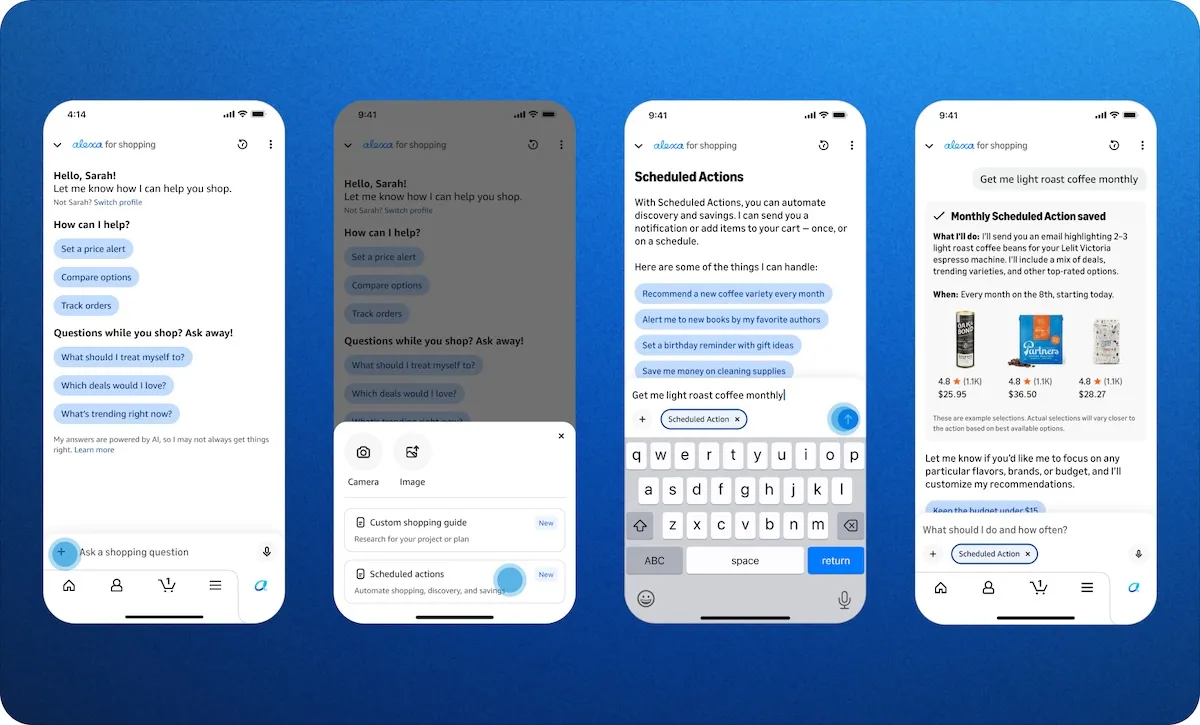
According to Amazon, the new assistant supports both voice and text interactions and can handle a broad range of shopping-related requests. Users can ask questions like “What’s a good skincare routine for men?” or “When did I last order AA batteries?” Alexa for Shopping can also generate custom shopping guides, schedule recurring purchases for household essentials, compare products, monitor pricing, and automatically add items to a cart once they hit a target price.
Amazon is also expanding the assistant beyond its own marketplace. Through the company’s “Buy for Me” feature, Alexa for Shopping can purchase products sold on other retailers’ websites on behalf of customers. The capability has already drawn criticism from some retailers who say they never agreed to participate in the system.
Daniel Rausch, Amazon’s top Alexa executive, said the company believes its approach is more reliable than competing AI shopping tools because Amazon controls core shopping infrastructure, including inventory, customer reviews, shipping information, and product availability.
“As I’m using it, I’m just realizing why other AI efforts have struggled with shopping because it’s not just scraping web results and then putting things in a conversation,” Rausch said in an interview.
The move comes as OpenAI, Google, Perplexity, and other AI companies increasingly push into online shopping tools and autonomous purchasing systems. Earlier this year, OpenAI abandoned Instant Checkout, a feature that allowed purchases directly through ChatGPT, and shifted toward retailer-built shopping applications instead.
Rausch said Amazon was not surprised to see competing AI companies retreat from some earlier shopping features.
“I wasn’t surprised others have basically had to undo a bunch of features” that felt incomplete or disconnected, he said. “It’s just not worth it. Shopping is not something you do as a side quest.”
Amazon has simultaneously tried to limit outside AI agents from accessing its marketplace while building its own shopping automation tools internally. CEO Andy Jassy previously said Amazon expects to eventually work with third-party AI agents, though the company still blocks many bots from accessing parts of its platform.
The rollout could also reshape how products are promoted across Amazon’s storefront. Alexa for Shopping will include advertising placements when relevant, potentially changing how customers discover products compared with traditional keyword-based search rankings and sponsored listings, which currently generate a major portion of Amazon’s advertising revenue.
Rausch said the assistant is not meant to reduce shopping choices but instead surface additional products based on context and user intent.
“It’s there to, in some cases, expose even more products for customers, depending on where you are in the journey,” he said.
This analysis is based on reporting from CNBC.
Images courtesy of Amazon.
This article was generated with AI assistance and reviewed for accuracy and quality.
