Under the new system, users can build an Android app in Google AI Studio and add it to a private section of Google Play. These personal apps will not appear in Play Store search results or public listings, and initially they will only be available to the person who created them.
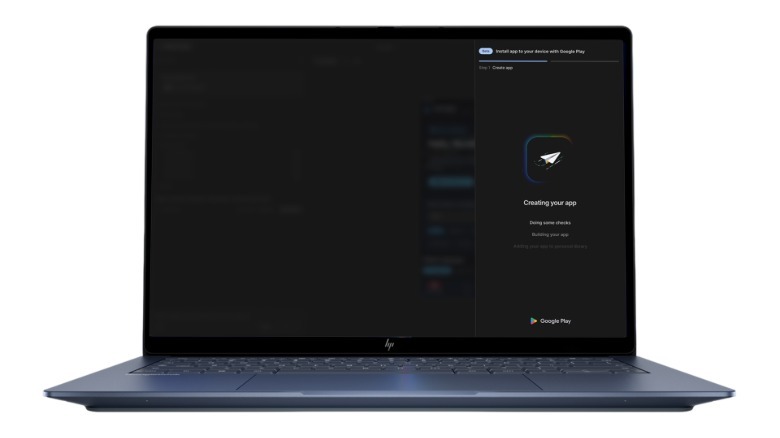
The apps can be used across the creator's compatible devices with access to Google Play, including phones, tablets and computers. They will still need to follow Google Play's existing policies.
Google plans to expand the feature so users can eventually share personal apps with a limited group of trusted people. That could allow someone to build software for friends, relatives or a small community without releasing it to the entire Play Store audience.
If a personal app later attracts broader interest, Google also plans to provide a path for its creator to move to a professional developer account and submit the app for normal Play Store review before making it publicly available.
“That's why the future of apps on Google Play is personal, secure, and built by everyone — and it's why Play is leading the charge and moving from ‘there's an app for that’ to ‘there's an app for me,’” Sam Bright, Google's VP and GM for the Google Play and Developer Ecosystem, said during a press briefing. “We started Google Play with a simple goal: to connect you with the apps you love. But after today, we hope it's clear: Play has evolved to become so much more than that.”
Google is pairing the new publishing option with several changes to how users discover apps and games.
A new Game Finder feature will use a player's preferences along with information from Google's gaming community of 1.2 billion players to recommend titles. The feature will initially be available in English in the U.S.
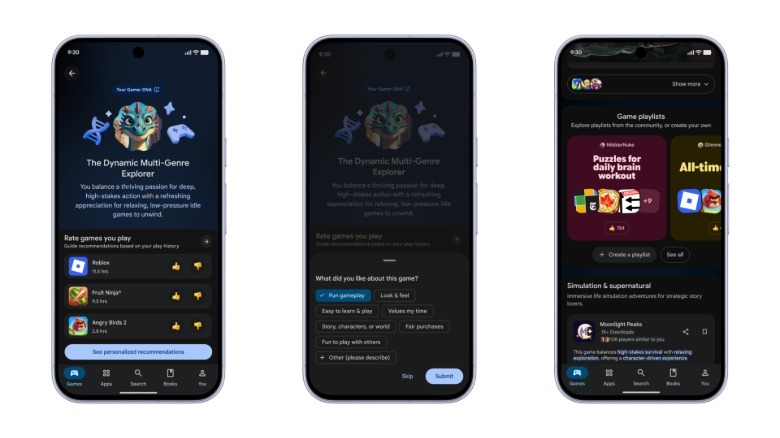
Google is also introducing a Gamer DNA profile that users can adjust according to their preferences and favorite genres. Players will be able to create their own game lists and recommend collections to other users.
Other gaming additions include Sprints, which are 48-hour challenges that group players with others at a similar skill level, and Community Posts, a new question-and-answer feature connected to game pages. Google is also expanding Quests so developers can provide in-game rewards in addition to Play Points.
The Sidekick gaming overlay is receiving an option for recording 30-second gameplay clips.
Google is also expanding AI-powered discovery elsewhere in the Play ecosystem. Ask Play, the Play Store's built-in AI assistant, will gain the ability to compare similar apps and highlight important differences between them.
Play Store content will also appear more directly inside Gemini conversations, allowing Google's AI assistant to surface links to apps and games. Google is expanding Play Store layouts for cars with Google built-in and for Android XR as well.
Separately, Google is adding support for an age-range feature that lets parents share a child's general age bracket with developers without providing the child's exact birthdate. Developers can use that information to provide experiences intended for the appropriate age group.
Taken together, the updates make Google Play a distribution channel not only for conventional public apps, but also for software people create for themselves with AI. The personal app system lowers the barrier between generating an Android application in Google AI Studio and actually using it on an Android device, while keeping those apps separate from the Play Store's public catalog.
This analysis is based on reporting from TechCrunch & Engadget.
Image courtesy of Google/ZDNET.
This article was generated with AI assistance and reviewed for accuracy and quality.
