Loper told Nieman Lab that he neither created nor signed the image. He also said it was not the first time he had encountered an AI-generated cartoon carrying his pen name.
“I had people writing to me about this cartoon, asking if it was mine,” Loper said.
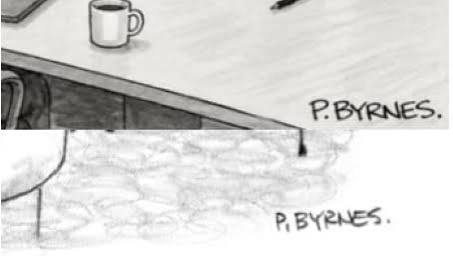
Additional examples appeared in a ChatGPT-focused Reddit forum, where users posted AI-generated cartoons carrying signatures associated with multiple New Yorker contributors. Nieman Lab documented more than 15 cartoonists whose names or signatures appeared on images created with OpenAI’s image generator, including Emily Flake, Harry Bliss, Joe Dator, Pat Byrnes and Jason Adam Katzenstein.
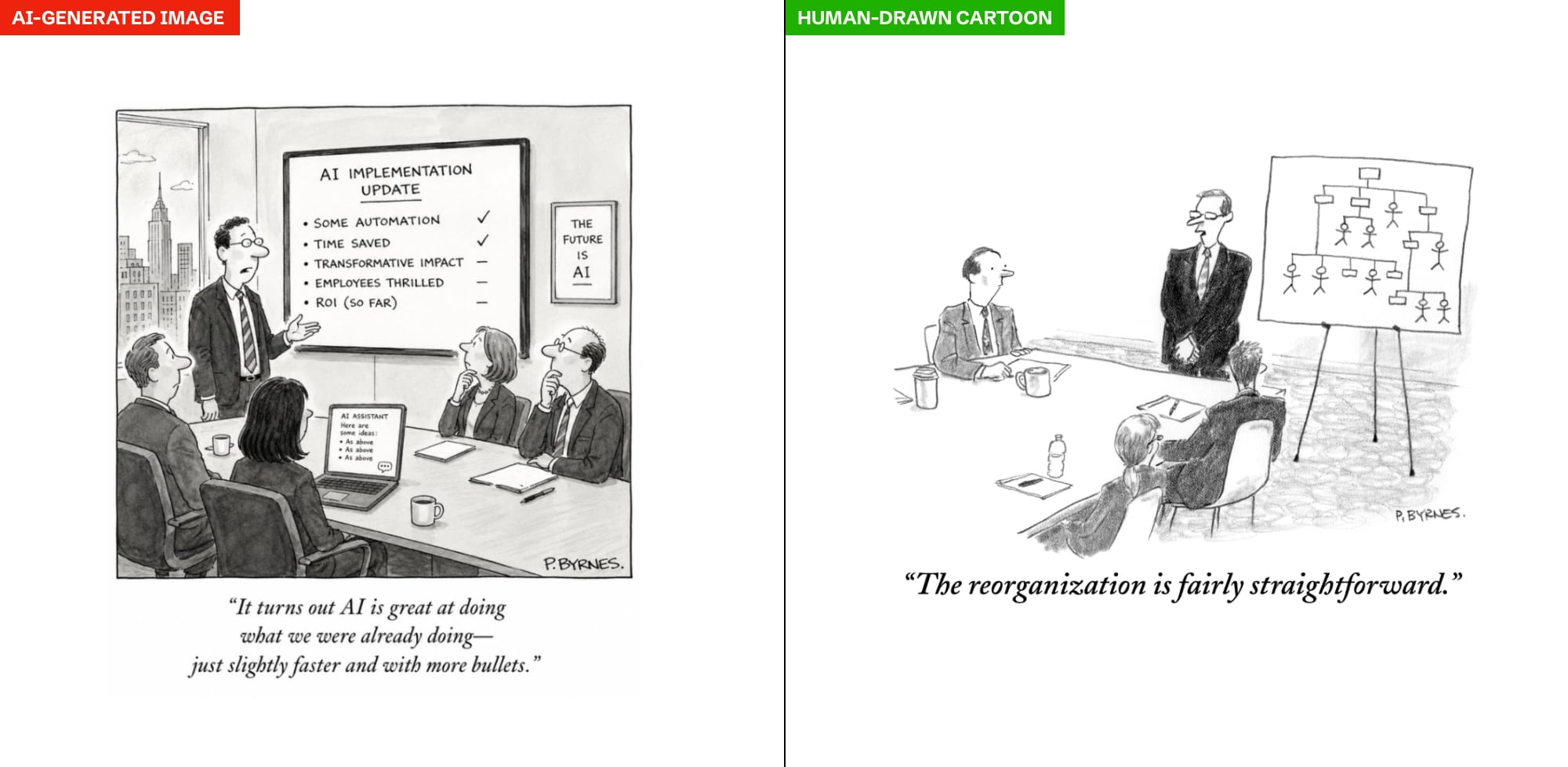
For the artists, the issue goes beyond visual imitation. Cartoonists often use their signatures as a way to identify and authenticate work that may circulate separately from its original publication.
“The signature for me is the certificate of authenticity,” Loper said. “If I put my name on it, it’s official, it’s mine. It really is a brand. It’s the mark that I made.”
Emily Flake, another New Yorker contributor, said some AI-generated images carrying her pen name contained elements that reminded her of her own work but did not look like cartoons she had drawn.
“I can see the DNA of my work in there, but it still doesn’t look like something I drew,” Flake said. “It’s kind of like seeing a distant cousin.”
She described the attribution problem more directly: “It’s like somebody attributed a quote to me that I didn’t say.”
The examples reviewed by Nieman Lab did not all contain signatures. Some included meaningless names, while others reproduced recognizable pen names belonging to established cartoonists. Several AI-generated images also resembled common characteristics associated with New Yorker cartoons, including black-and-white line art, sparse scenes and short captions.
OpenAI described the issue as unintended behavior.
“We believe the future of creativity is one that is fundamentally human, and our focus is on building tools that empower human creativity and creators,” an OpenAI spokesperson said. “We very much appreciate the community flagging bugs and unintended behavior by our models, so we can address them.”
After Nieman Lab contacted OpenAI, ChatGPT began displaying warnings on some prompts requesting New Yorker-style cartoons. The warning said the request “may violate our guardrails concerning similarity to third-party content.” According to Nieman Lab, however, the system continued generating some images and occasionally still attached signatures associated with real artists.
Separate testing by Yahoo Tech also produced the requested New Yorker-style images, though its examples did not contain artist signatures. Some prompts triggered similar guardrail warnings.
The dispute also touches on OpenAI’s relationship with Condé Nast, The New Yorker’s parent company. The publisher reached a licensing agreement with OpenAI in 2024, but a New Yorker spokesperson told Nieman Lab that the arrangement did not authorize AI developers to train models on the magazine’s cartoons.
Nieman Lab also reviewed standard agreements used with New Yorker cartoonists and reported that the artists retain ownership of their copyrights. The contracts it examined did not permit the cartoons to be licensed for AI training.
OpenAI did not explain to Nieman Lab how its models learned or reproduced the signatures.
The fake attributions add a different problem to the broader debate around AI-generated media. Instead of merely creating content that resembles an artist’s style, the system can place a recognizable name on work that the person never created.
Some cartoonists said that distinction is especially important because their signatures represent their professional identities.
“ChatGPT is attaching my name to work that I do not endorse or like,” Katzenstein said. “It’s slop, and unlike the other slop that I’ve encountered, this is slop that’s pretending to be me.”
Joe Dator, another longtime New Yorker contributor, compared the experience to a more personal form of impersonation.
“I’ve had people hack my credit card,” Dator said. “That feels like less of a violation than this. When they hacked my credit card, they didn’t dress up like me.”
The legal implications remain unsettled. Cornell Law School professor James Grimmelmann told Nieman Lab that copyright questions would likely focus more heavily on whether an AI system reproduced protected elements of a cartoonist’s work than on the signature itself.
“ is an indication of authenticity, but attribution is a very small part of the fair use inquiry,” Grimmelmann said.
He also said artists might potentially look to right-of-publicity laws, which address unauthorized commercial use of a person’s identity. Such a claim would depend on how the AI-generated material was used.
For cartoonists, however, the immediate concern is less abstract. A signature that traditionally tells readers who created an image can now appear on material generated by an AI system instead, making authorship itself harder to verify.
This analysis is based on reporting from The Daily Cartoonist & Nieman Lab.
Images courtesy of Nieman Lab.
This article was generated with AI assistance and reviewed for accuracy and quality.
