The new model supports a context window of one million tokens, allowing it to process large amounts of information across documents, spreadsheets, PDFs, images, audio and video. Google says Neon can combine details from these different sources to produce structured reports, summaries and analyses, rather than handling each file independently.
For Gemini app users, the improvements are intended to make complicated research and document-heavy tasks easier to complete. Google highlighted examples such as examining utility statements to identify unexpected charges, comparing receipts to support refund requests and evaluating information from multiple sources before making a purchase.
Neon can also incorporate information from connected Google services, including Gmail and Docs, and retrieve current information from the web when preparing research. Google says the model produces clearer written responses and follows complicated instructions more reliably than earlier versions.
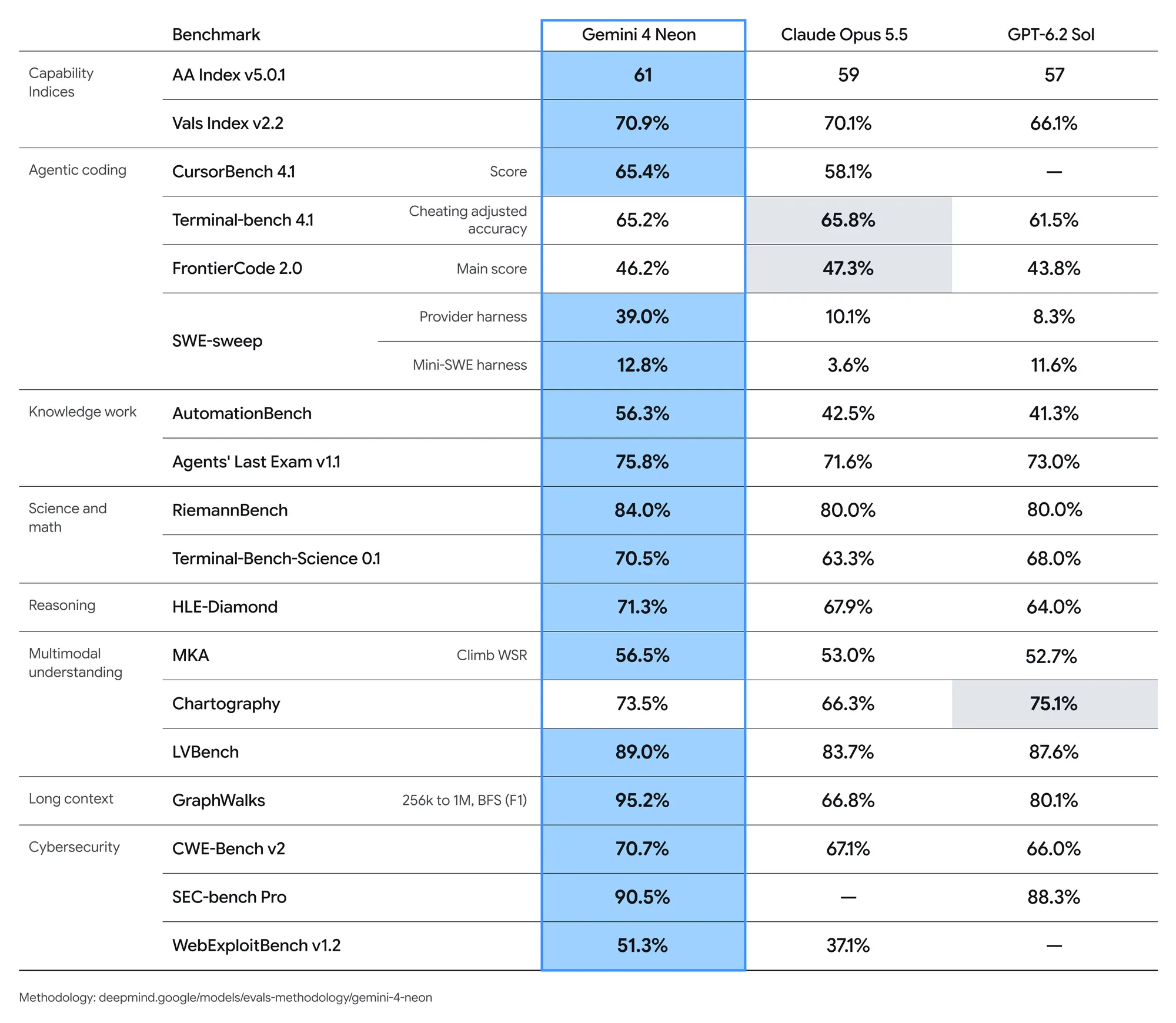
The company is emphasizing performance alongside those capabilities. According to Google's published benchmark results, Neon scored 61 on the Artificial Analysis Intelligence Index at its highest reasoning setting, placing third overall. It also ranked second on the Vals Index with a score of 70.9%.
On the Artificial Analysis benchmark, Google's reported results put Neon ahead of Claude Opus 5.5, which scored 59, and GPT-6.2 Sol, which scored 57. However, the comparisons were not uniformly favorable to Google.
GPT-6.2 Sol outperformed Neon on Chartography, a benchmark measuring chart interpretation, with scores of 75.1% and 73.5%, respectively. Claude Opus 5.5 also narrowly exceeded Neon on Terminal-Bench 4.1, scoring 65.8% compared with Neon's 65.2%.
These figures come from Google's published comparisons and do not establish that the models were evaluated under identical configurations. They also do not directly measure how consistently the systems perform on everyday consumer tasks.
Beyond general reasoning, Google is targeting software development and automated workflows. Neon is designed to handle extended coding sessions, debug projects involving multiple files and coordinate tasks that require several tools or AI agents.
Within Google Antigravity, the model can act as a coordinating agent that directs smaller Gemini 4 Hydrogen agents working in parallel. Google says this approach helps Neon manage complex development projects while reducing unnecessary operations and maintaining context throughout longer sessions.
The company reported that Neon ranked first on the Artificial Analysis Coding Agent Index with a score of 58.6. It also achieved 46.2% on FrontierCode 2.0 at its default high reasoning setting.
Google demonstrated the model working on projects that included an interactive skiing simulator, a three-dimensional recreation of Alan Turing's study and a spreadsheet containing more than 100,000 cells generated from a single image.
Neon is also being positioned for business and scientific applications. Google's results placed it first on several evaluations involving legal research, tax analysis, finance and spreadsheet modeling, while the company reported strong performance on mathematical and scientific reasoning benchmarks.
Efficiency is another focus of the release. Google says early evaluations found Neon could match or exceed Gemini 4 Carbon's overall quality while completing tasks three times faster at 60% of the cost. The company also reported a 32% reduction in cost per task compared with Carbon at Neon's default high reasoning setting.
For developers accessing the model through the Gemini API, pricing starts at $3 per million input tokens and $15 per million output tokens. Cached input costs $0.15 per million tokens, representing a 95% discount from the standard input rate.
Neon offers four reasoning-effort settings, allowing developers to adjust the amount of computation used for different workloads. Its highest setting is intended for particularly demanding engineering, scientific and analytical problems.
Google is also highlighting security improvements, including stronger performance on tests involving software vulnerabilities and resistance to malicious instructions embedded in external content. The company says Neon achieved its lowest fabrication rate yet in internal Antigravity testing and improved on several measures of agent reliability.
A specialized cybersecurity version is scheduled to reach eligible participants in Google's Fairwind Program over the coming days. Google says the model can assist with identifying vulnerabilities, evaluating whether weaknesses can be exploited and developing patches.
For consumers, access is tied to paid Gemini subscriptions. Google AI Pro and Ultra subscribers can select Neon through the Gemini app's model menu as the rollout progresses. Developers and enterprise customers have separate access options through Google's API and business products.
The release adds another model to Google's Gemini 4 family without replacing the distinct roles assigned to Hydrogen and Carbon. Neon is intended for users who need more analytical depth than an everyday assistant provides but want faster, more economical execution than Google's largest models.
While Google's benchmark results indicate competitive performance across reasoning, coding and enterprise tasks, the company has not provided independent measurements of response times or reliability in ordinary Gemini app usage. How much users benefit will depend on the complexity of their work and how the model performs outside controlled evaluations.
This analysis is based on reporting from Google.
Images courtesy of Google.
This article was generated with AI assistance and reviewed for accuracy and quality.
