The update centers on improving how the model executes difficult programming work. Anthropic said users can now delegate more complex coding tasks with less oversight, citing stronger consistency, tighter adherence to instructions, and the ability to validate its own outputs before responding. These improvements are aimed at workflows that extend beyond simple prompts into sustained, multi-step execution.
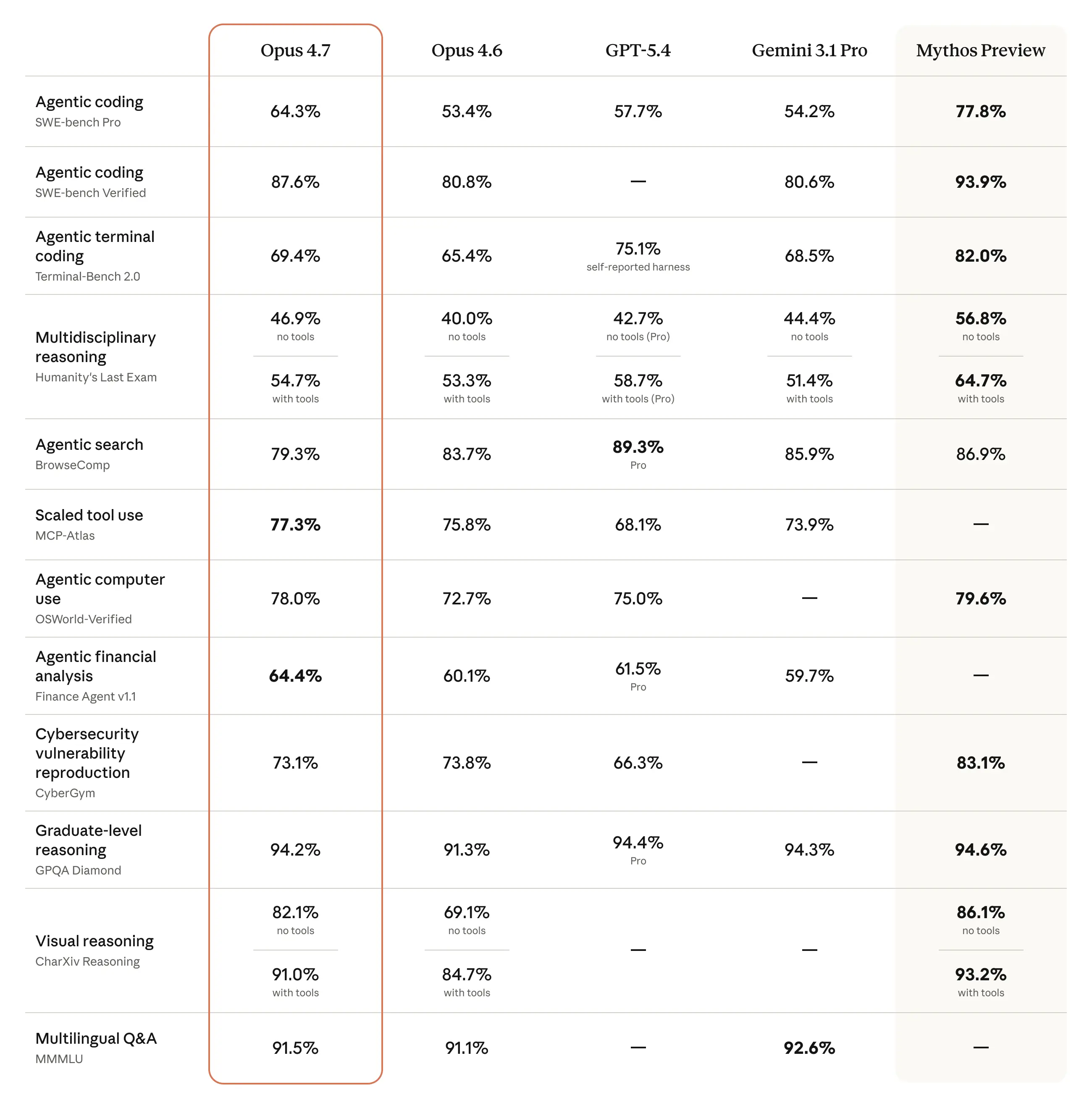
Alongside coding gains, the model introduces expanded multimodal capabilities, including support for higher-resolution image inputs. It can process images up to 2,576 pixels on the long edge, enabling use cases that depend on detailed visual analysis, such as interpreting dense screenshots or extracting information from diagrams.
The release also includes changes tied to safety and cybersecurity. Opus 4.7 is the first model in a planned rollout that tests updated safeguards designed to detect and block high-risk cybersecurity requests. Anthropic said these controls will inform future releases of more advanced models, including its limited-access Claude Mythos Preview.
“This is the first such model,” the company noted, referring to Opus 4.7’s role in testing new cyber safeguards before broader deployment.
To support legitimate security work, Anthropic introduced a Cyber Verification Program, allowing vetted professionals to access the model for use cases such as vulnerability research and penetration testing.
Additional updates accompany the model release. These include a new “xhigh” effort setting that lets developers balance reasoning depth and latency, as well as tools like task budgets in the API to manage token usage during longer runs. In its Claude Code environment, Anthropic also added features such as an “/ultrareview” command for code analysis and expanded automation options.
The company said Opus 4.7 uses an updated tokenizer and may consume more tokens in certain scenarios, particularly when running at higher effort levels. However, it said internal testing showed overall improvements in efficiency when applied to coding tasks.
Anthropic described the model as an incremental upgrade over Opus 4.6, with similar safety characteristics but improvements in areas such as instruction-following and resistance to prompt injection.
This analysis is based on reporting from anthropic.
Image courtesy of Anthropic.
This article was generated with AI assistance and reviewed for accuracy and quality.
