The platform brings several existing Binance technologies into a common developer environment. It combines Binance APIs, Wallet Agentic Hub, Skill Hub and x402 programmable payments with support for Model Context Protocol, or MCP. The open standard provides a shared method for AI applications to connect with external tools and services.
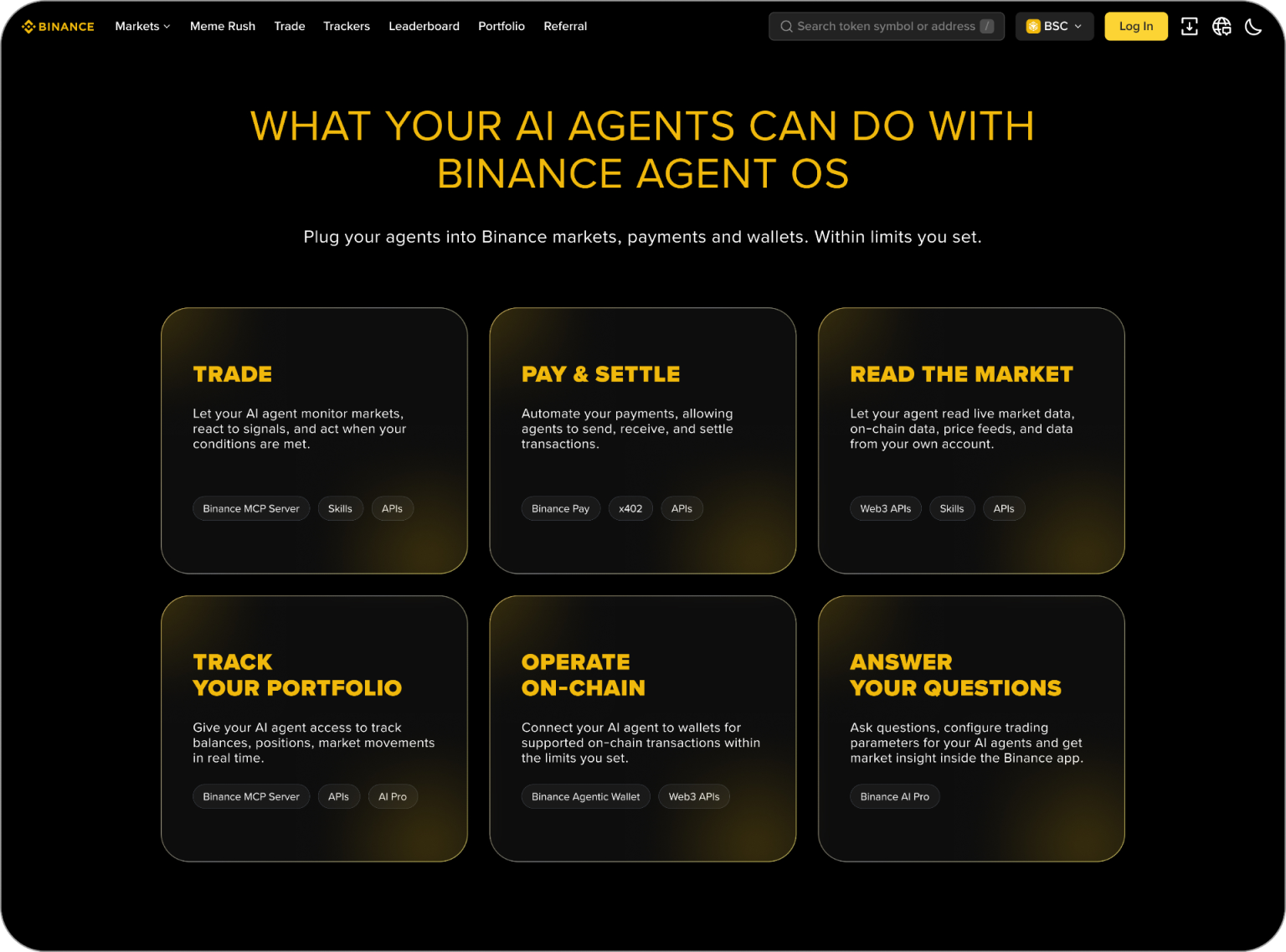
For developers, MCP reduces the need to build a separate connection for each Binance product an agent needs to use. The initial implementation supports market information, read-only account access and trading functions. “It gives everyone from developers to quantitative traders the reliable data, low-latency infrastructure, and standardized interfaces they need to deploy AI-driven strategies,” Binance Vice President of Product Jeff Li said.
Users retain control over which capabilities an AI agent receives. They can authorize individual agents, establish permissions and revoke access. Agents can also operate through dedicated subaccounts, separating their funds and activity from other parts of a user’s account.
Within an assigned subaccount, an agent can access balances, portfolio details and transaction records. It can also view balance and portfolio information associated with the main account. Personal information, including email addresses and KYC data, remains inaccessible to agents.
The subaccount structure also provides a boundary around an agent’s financial activity. Withdrawals from these accounts are disabled by default, while users control the amount of money allocated to an agent and the permissions it receives.
For onchain activity, Binance applies additional limits through its Agentic Wallet. Regular swaps have a $50,000 daily cap, while DeFi transactions have a default daily limit of $100,000 and x402 payments are limited to $20 per day. Trading conducted directly through a subaccount does not have a separate agent-specific ceiling beyond the funds the user places there.
Binance also separates the AI system’s reasoning from its own oversight of transactions. An agent can perform its reasoning within the AI application or the user’s environment, while Binance retains visibility into activity executed through its infrastructure, including resulting orders. The exchange applies its existing controls to those transactions.
That distinction becomes important when an AI agent is given authority to act rather than simply provide information. An agent interacting with outside material could potentially encounter content that influences its behavior in unintended ways. Binance points to dedicated subaccounts, permissions and its existing security, risk-control and anti-money-laundering measures as safeguards around activity conducted through Agent OS.
The launch puts ChatGPT, Codex, Claude Code and Cursor among the AI applications that can interact with Binance infrastructure when users grant the necessary authorization. Instead of limiting those tools to market research or generating trading ideas, Agent OS creates a standardized route for agents to move from analysis to supported financial actions.
Agent OS forms part of Binance Intelligence, the company’s broader effort around AI-powered financial products. With the new platform, Binance is giving developers a unified layer for building agents that can interact with its trading and financial services while keeping access constrained by permissions and account boundaries set by users.
This analysis is based on reporting from Crypto Briefing.
Images courtesy of Binance.
This article was generated with AI assistance and reviewed for accuracy and quality.
