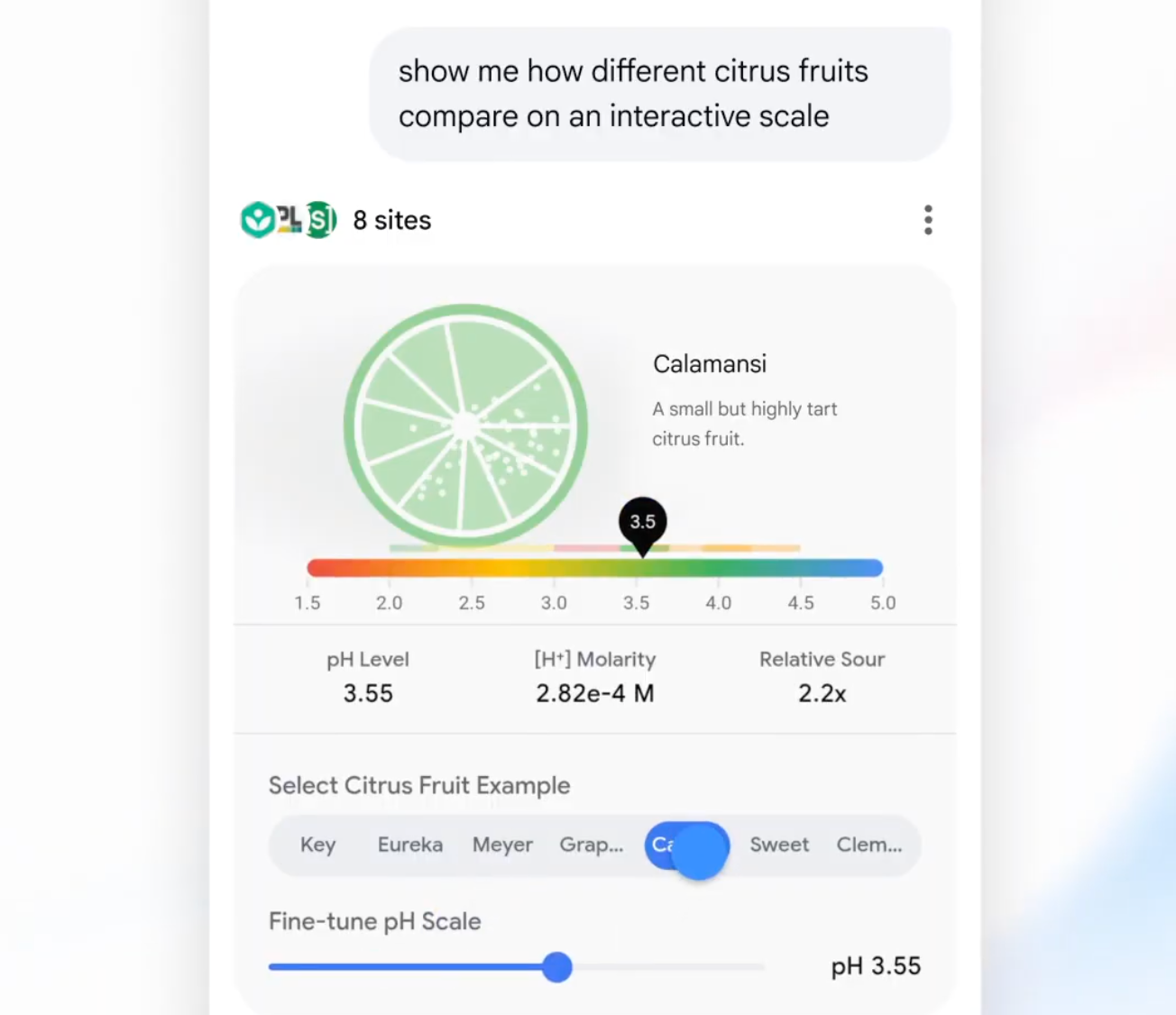
Google says generative UI is available globally in English through AI Mode and has also begun reaching AI Overviews. Students can either refine an existing search or describe the particular educational tool or visualization they want AI Mode to create.
Search is also gaining interactive practice quizzes covering subjects including science, mathematics, humanities and foreign languages. Students preparing for standardized exams can request material for the ACT, AP, ENEM, GRE, JEE, LSAT, MCAT, NEET and SAT.
Google is incorporating test-preparation material through partnerships with The Princeton Review, Careers360, PhysicsWallah and Akira Enem. Quizzes can provide explanations for individual answers and links to additional information. The feature is available globally in English at no charge through both AI Mode and AI Overviews.
Lens is getting a separate learning experience aimed at helping students work through problems from images. In the coming weeks, users will be able to photograph their work through the Lens camera in the Google app and receive an AI Overview that explains the material, identifies possible mistakes and offers guidance when they get stuck. Students can then continue asking questions through AI Mode while consulting related sources from the web. Google says the Lens learning experience will become available globally in English over the coming weeks.
The company is also bringing notebooks directly into AI Mode. The feature builds on Gemini Notebook, formerly known as NotebookLM, and gives students a way to organize reference material around individual courses or projects without leaving Search. A notebook can contain material including class slides, syllabi and web articles, as well as previous AI Mode conversations. Students can then ask questions or examine a topic using those sources as the underlying reference material.
Existing notebooks from Gemini Notebook and the Gemini app will automatically appear in Search, with their sources and instructions synchronized across Google's products. The AI Mode integration is rolling out over the coming days in English across more than 180 countries, with additional language support planned for the following weeks.
Google is also adding file-generation capabilities to AI Mode. Students can combine uploaded material with previous AI Mode conversations and ask Search to produce a new study resource. One example provided by Google involves uploading handwritten notes and lecture slides, then requesting a single-page document covering the main concepts. The initial file-generation options include documents, presentations, spreadsheets and text files across multiple formats. The capability is already available globally in English through AI Mode and is also planned for AI Overviews.
Taken together, the additions move more of the study process directly into Google's search experience. Students can use Search to generate an explanation, interact with a visualization, test themselves with a quiz, organize source material into a notebook and turn that material into new study files.
Google is framing the features around learning rather than simply producing answers. With Lens, AI Mode and AI Overviews working across different parts of the same workflow, the company is giving students multiple ways to continue from an initial question into guided explanations and reference-based study.
This analysis is based on reporting from Google.
Images courtesy of Google.
This article was generated with AI assistance and reviewed for accuracy and quality.
