Those primitives include Choice, Score and Noul, each producing a different form of machine-readable response. A customer service system, for example, could ask Jev which department should handle a billing complaint and receive probability values for billing, technical support and sales rather than a written explanation.
TypeSafe says that structure is intended to reduce the parsing and validation work developers often need when using text-generating models inside software. It also allows applications to use confidence scores when deciding whether to act automatically or hand a case off for further review.
Jev is built on an architecture TypeSafe calls System One, which uses Reinforcement Learning for Calibrated Decisions, or RLCD. The model is designed to produce multiple outputs in parallel instead of generating text one token at a time.
The company says that approach gives Jev significantly lower latency than conventional LLMs. TypeSafe claims response times ranging from 70 milliseconds to 500 milliseconds, while a demonstration on its website showed Jev completing a request in 0.114 seconds compared with 8.566 seconds for OpenAI’s GPT-5.6 Terra.
TypeSafe also says Jev can process hundreds of outputs at once from a single prompt. The company describes the model as being up to 100 times faster and less expensive than other frontier models, while separately claiming speed advantages of 40 to 200 times over traditional LLMs.
Pricing is another part of the pitch. Jev costs $0.042 per million input tokens and carries no output-token charge. TypeSafe compares that with GPT-5.6 Terra at $2 per million input tokens and $12 per million output tokens.
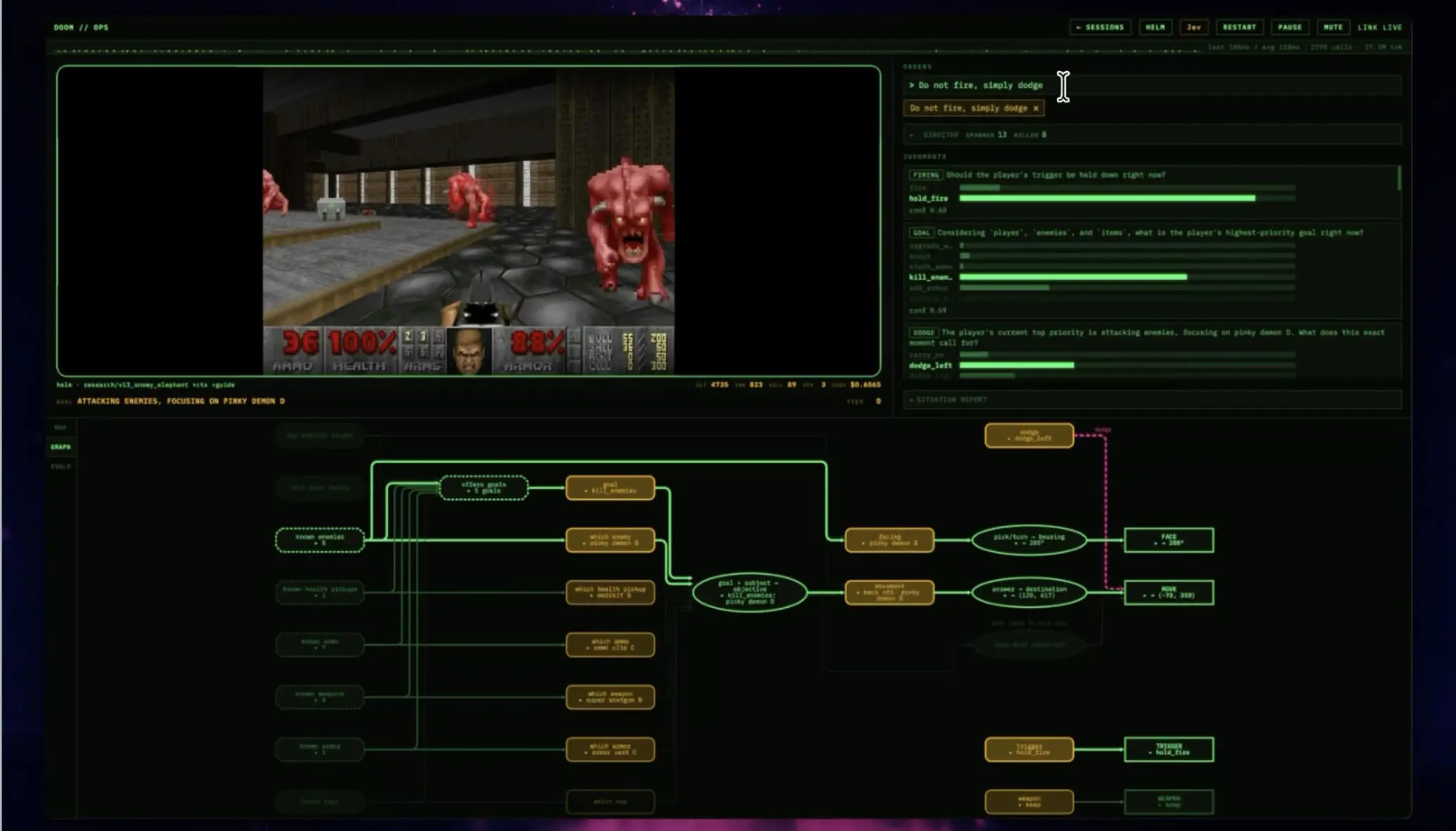
The model is aimed at workloads where software needs to make repeated decisions rather than hold a conversation. TypeSafe lists AI agent tool calls, real-time applications, large-scale classification, input verification and model orchestration among the intended use cases. The company has also demonstrated Jev playing Doom from structured game-state information.
TypeSafe says Jev is “hallucination-free,” although the model can still return an incorrect decision. Its outputs are constrained to typed values and probabilities rather than open-ended prose, which means the failure mode differs from a language model fabricating text.
The company argues that this matters when AI is embedded deep inside automated systems. “Having a hallucinated tool call is inconvenient in an agent, but is an absolute deal-breaker if it’s part of a system with latency guarantees or it’s buried several layers deep in a dependency chain,” TypeSafe said. “Existing models, no matter how smart, still hallucinate and have type errors.”
TypeSafe was founded by Diogo Almeida, Erik Gafni and Sasha Sheng. Almeida is a former OpenAI researcher and co-inventor of reinforcement learning from human feedback and ChatGPT.
“TypeSafe was founded to pursue an alternative path for AI research, focused on machine-native AI,” Almeida said. “I spent years working on models designed to make AI better at interacting with people. But if AI is going to fundamentally change how work gets done, people can’t be the only consumers of intelligence.”
The company’s $40 million seed round was led by DCVC. Jev is currently available in early access for select developers.
Its name references Jevons Paradox, the idea associated with economist William Stanley Jevons that efficiency improvements can increase overall consumption rather than reduce it. TypeSafe is making a similar bet on AI: that cheaper, faster inference could drive more software to use machine intelligence in the background.
Rather than trying to compete directly with chatbots such as ChatGPT or Claude, TypeSafe is focusing on AI that acts as a component inside software. Its bet is that some of the most useful AI systems will not talk to users at all, but will instead make structured decisions that other applications can consume.
This analysis is based on reporting from The Register.
Images courtesy of Typesafe AI
This article was generated with AI assistance and reviewed for accuracy and quality.
