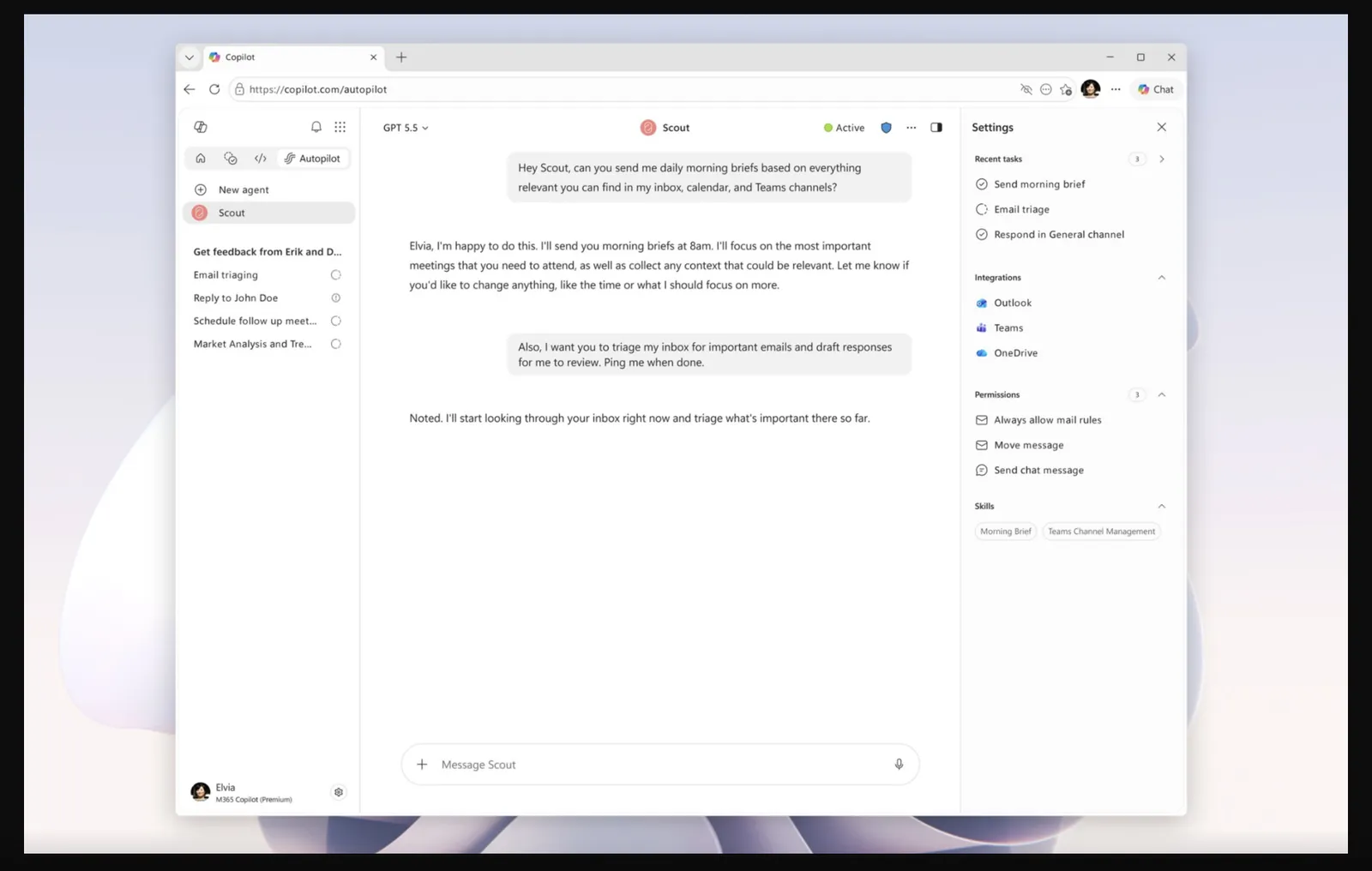
Microsoft is introducing Scout, a new AI agent designed to work inside Microsoft Teams by handling tasks such as reviewing messages, managing calendars, resolving scheduling conflicts, and drafting responses. The company unveiled the tool at its Build developer conference, positioning it as part of a broader effort to bring AI agents into everyday workplace workflows.
Scout is built to operate as a persistent assistant for knowledge workers. Users can interact with the agent directly within Teams, assigning tasks much like they would to a colleague. According to Microsoft, Scout can access work messages, email, and calendar data to automate administrative tasks and help users stay on top of commitments and deadlines.
“The whole point of having a personal assistant is that they’re working when you’re not working,” Omar Shahine, Microsoft’s corporate vice president of Microsoft Scout, said during the announcement.
One of the agent’s core capabilities is proactive task management. Users can define preferences and goals, allowing Scout to take action on their behalf. Shahine said he configured the assistant to protect family dinnertime, enabling the agent to flag meeting requests during those hours and propose alternative scheduling options. The tool can also review messages and email to identify commitments, track outstanding requests, and generate reminders for unfinished work.
Microsoft is initially launching Scout with a limited group of customers before expanding availability. Alongside the Teams integration, the company is testing a dedicated desktop application. That app is rolling out to users who have opted into Microsoft’s “frontier” feature access program and currently requires an active GitHub Copilot subscription.
The company acknowledged that the product remains an early-stage release. Shahine described instances where the agent’s output still required refinement, including one email that lacked formatting and was generated as a single run-on sentence. Microsoft said the goal is to give users control over which responsibilities they choose to automate and which tasks remain under direct human oversight.
Security and governance are also part of the rollout. Because Scout can access workplace communications and perform actions on a user’s behalf, Microsoft said it is building administrative controls that allow organizations to monitor agent activity. The company is also limiting the initial deployment as it evaluates how the system performs in real-world environments.
Scout arrives as major technology companies increasingly compete to bring AI agents into workplace software. Microsoft is betting that persistent assistants capable of managing communications, schedules, and follow-up tasks can become a regular part of how employees work inside collaboration platforms.
For Microsoft, Scout represents another step in its effort to embed AI throughout its productivity products, extending beyond content generation and into ongoing workplace coordination. Rather than waiting for users to initiate requests, the agent is designed to continuously monitor work-related information and take action when needed.
About this article: This article was generated with AI assistance and reviewed by our editorial team to ensure it follows our editorial standards for accuracy and independence. We maintain strict fact-checking protocols and cite all sources.
Word count: 487Reading time: 0 minutes
Explore More AI Resources
Continue with high-value guides related to this topic.
Join thousands of weekly readers — the latest AI news, free in your inbox.
🤖 3 times a week📊 Industry analysis💡 Breaking news
Enjoying this article?
Get a free month of ChatAI Plus or Pro
🎁 Limited time offer
🔒 Once per user
ChatAI Plus & Pro unlock multi-model chat (GPT, Claude, Gemini & more), our productivity tools, and ad-free reading. Subscribe to our newsletter and take a 2-minute survey to claim one month free — no strings attached.