Copilot Cowork is designed to handle complex, multi-step tasks that require multiple tools and extended execution times. Unlike traditional AI assistants that provide recommendations or draft responses, Microsoft said Cowork is built to complete tasks end-to-end and return finished results.
According to Microsoft, organizations have used the system for a wide range of business processes, including automating spreadsheet management, generating dependency flow charts, comparing thousands of files across product versions, and analyzing sales pipelines to identify at-risk opportunities. The company described Copilot Cowork as the fastest-growing feature in the history of its Frontier program and said it has achieved some of the highest user satisfaction scores among Microsoft’s Copilot and agent experiences.
Microsoft said several architectural decisions distinguish Cowork from other AI offerings. The platform operates in the cloud rather than on local devices, supports Work IQ for business context, runs within Microsoft 365 security and compliance controls, and uses a multi-model approach that allows different models to be selected based on task requirements.
At launch, Copilot Cowork runs on Anthropic models including Opus 4.8 and Sonnet 4.6. Customers in Frontier can also access GPT 5.5. Microsoft said its own model, Cowork 1, is expected to arrive in the coming weeks and has been post-trained to perform tasks at a lower cost. “Our newest model, Cowork 1, will be a secure, fine-tuned model releasing in the coming weeks, post-trained to handle tasks at a substantially lower cost,” Microsoft said.
The company also highlighted pricing as a key component of the launch. Copilot Cowork requires a Microsoft 365 Copilot User Subscription License and uses a consumption-based billing model. Task pricing is determined by model usage, context retrieval, tool calls, and runtime, with charges measured through Copilot Credits.
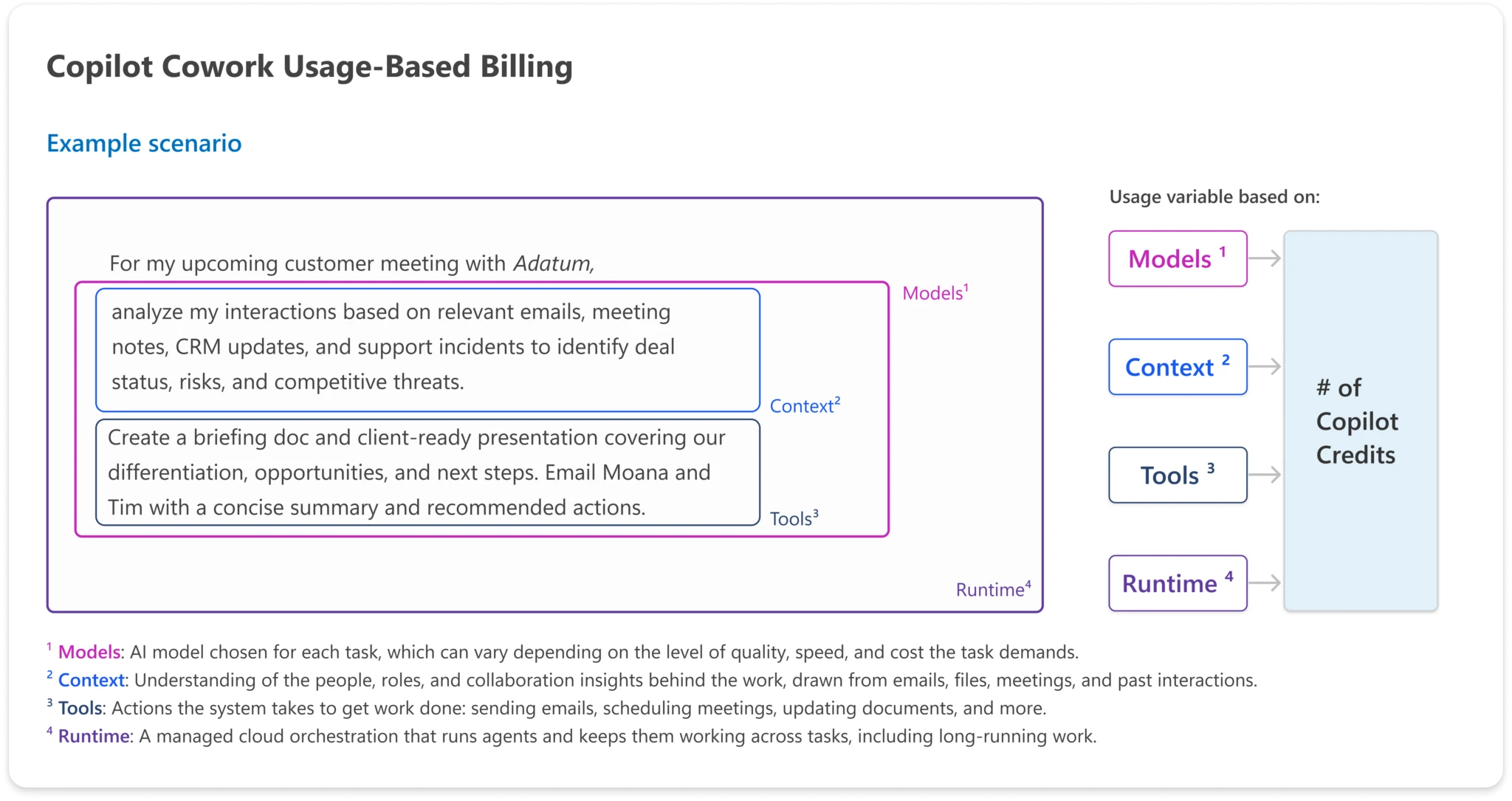
Microsoft said customers can choose between pay-as-you-go billing and a prepaid usage model called P3. Under the pay-as-you-go option, Copilot Credits are priced at $0.01 each.
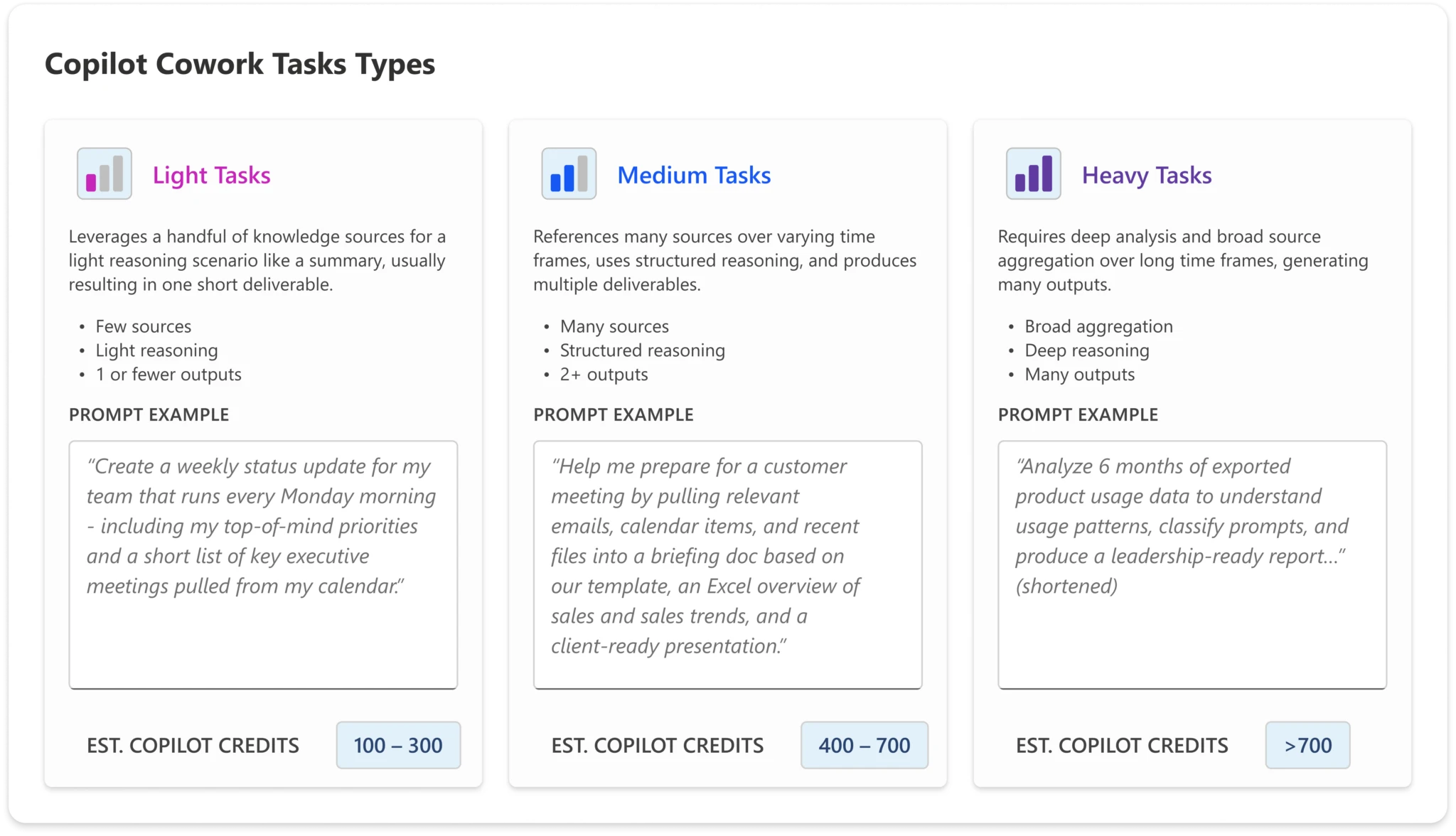
To help organizations manage spending, Microsoft is introducing a set of new cost-management controls. These include tenant, group, and user-level spending limits, customizable usage alerts, detailed reporting, and user-initiated credit requests. The company also plans to add user-level task pricing visibility after general availability.
The release introduces several new product capabilities. The Microsoft 365 Copilot application now includes a dedicated toggle that provides access to the full Cowork experience. Microsoft is also expanding integrations through partner plugins.
Plugins available at launch include Enosix, Harvey, LSEG, Miro, monday.com, Moodys, Morningstar, S&P Global Energy, and TeamsMaestro. Additional integrations from Adobe, Atlassian, Box, Canva, CB Insights, Databricks, MoneyForward, and Templafy are planned. Microsoft also said Fabric and Dynamics 365 Sales, Customer Service, and ERP applications are now generally available within the platform.
Microsoft is also expanding browser-based capabilities through Edge and adding new security and compliance features. The company said prompts, responses, and generated content are governed through existing Microsoft 365 controls, with support for audit logs, Data Security Posture Management, eDiscovery, Insider Risk Management, Data Lifecycle Management, and Communication Compliance policies. Data Loss Prevention support is expected later.
Billing for Copilot Cowork begins immediately. Microsoft said organizations that participated in the Frontier program between March 30 and June 16 and used Cowork during that period will receive a grace period and will not be billed until July 1, 2026.
With general availability now underway, Microsoft is positioning Copilot Cowork as a new category of AI-powered workplace tool focused on executing long-running business tasks while operating within existing Microsoft 365 governance, compliance, and security frameworks.
This analysis is based on reporting from Microsoft.
Images courtesy of Microsoft
This article was generated with AI assistance and reviewed for accuracy and quality.
