The update also changes how the model interacts with users during agentic tasks. Muse Spark 1.3 is trained to ask clarifying questions when a request is unclear, seek help when it gets stuck and request confirmation before taking consequential actions.
Meta says the model is better at preserving detailed requirements during multi-step work and less likely to lose constraints as a task grows longer. It also improves task routing inside crowded conversations, including cases where users interrupt or redirect earlier requests.
Another focus is calibration. Meta says Muse Spark 1.3 has a stronger sense of what it can and cannot do, what information it does or does not have and when it has encountered a blocker, reducing the likelihood that it will claim success when a task has not actually been completed.
Coding performance received a separate round of improvements. Meta says the model was trained on more long-horizon software engineering tasks and is less verbose than Muse Spark 1.2, while taking fewer unnecessary turns.
In internal comparisons by Meta engineers, Muse Spark 1.3 used about 20% fewer tool calls and roughly 25% fewer tokens than Muse Spark 1.2. The company also says its coding style is cleaner and its overall workflow is faster and more efficient.
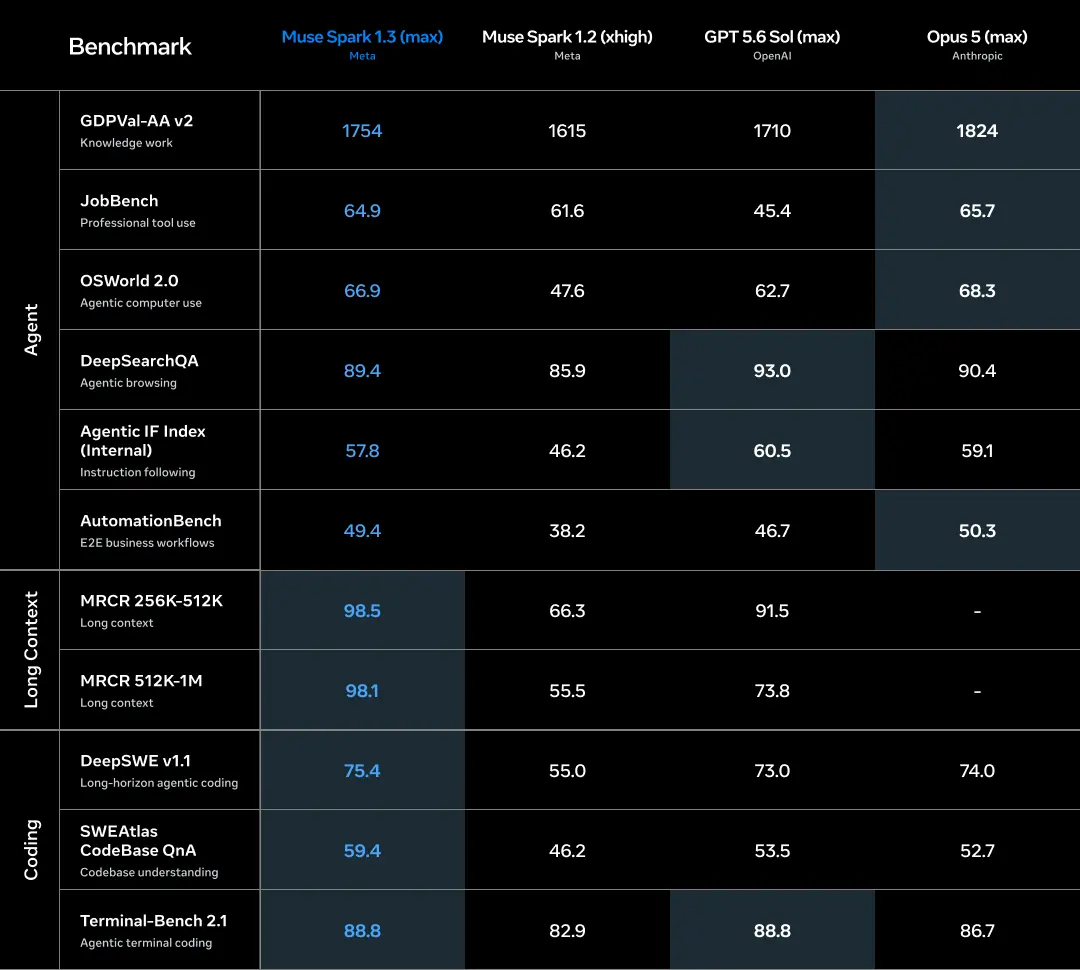
Meta’s benchmark results show the model scoring 75.4 on DeepSWE v1.1, a long-horizon software engineering test, ahead of the GPT 5.6 Sol and Opus 5 results shown in the company’s comparison chart. Muse Spark 1.3 also posted gains over Muse Spark 1.2 in Meta’s long-context evaluations, while rival models remained ahead on some other tests.
The model is also being positioned for practical work beyond coding. Meta demonstrated Muse Spark 1.3 generating a draft aerospace flow-simulation report from CFD results and a STEP file, organizing the output into a structured PDF with engineering metrics, tables and recommendations.
Safety work in the release centers on the same agentic capabilities Meta is expanding. The company says Muse Spark 1.3 is more resistant to adversarial inputs and prompt injection, and is better at recognizing when an action may be irreversible before proceeding.
Muse Spark 1.3 is available through Muse Code on macOS and Linux, as well as through the Meta Model API. Meta says larger models, an open-weights release of Muse Spark and additional updates are also on its roadmap.
This analysis is based on reporting from Meta.
Images courtesy of Meta.
This article was generated with AI assistance and reviewed for accuracy and quality.
