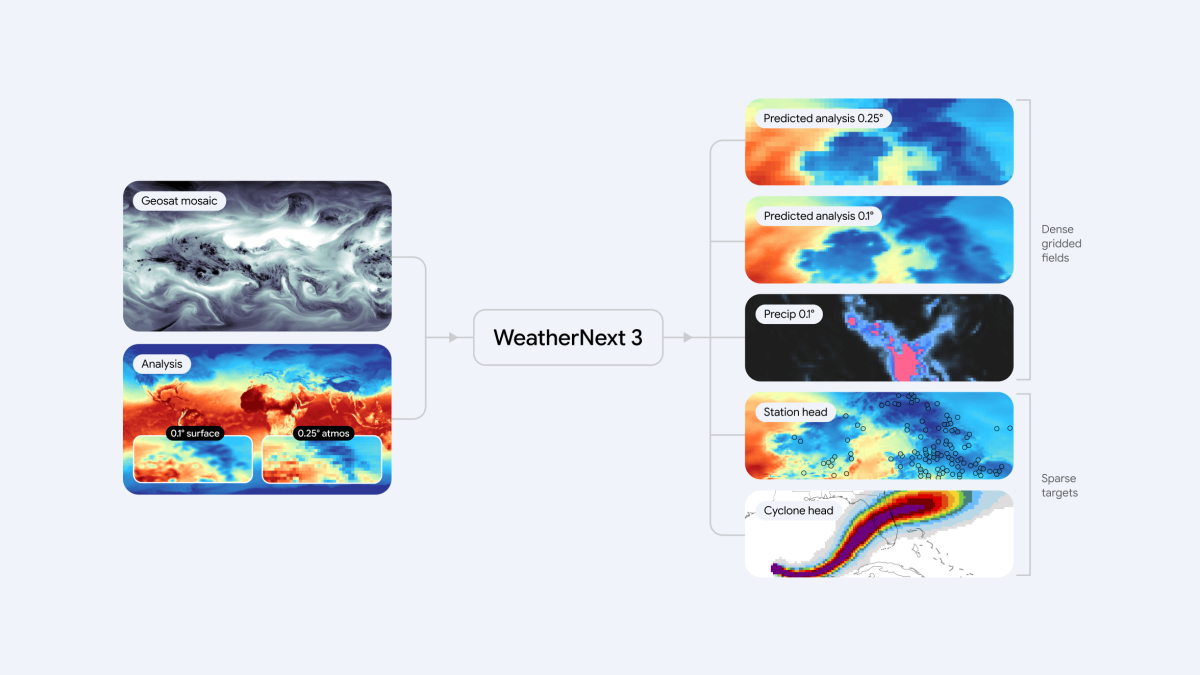
Google DeepMind and Google Research introduced WeatherNext 3 today, a new AI weather model that produces hourly global forecasts at resolutions as fine as 5 kilometers. The model is beginning to power weather information across Google Search, the Gemini app, Google Maps, Google Maps Platform Weather API and Google Earth Engine, while its forecast data is also being made available through Google Cloud tools.
WeatherNext 3 is designed to improve on two persistent limitations in AI weather forecasting: local detail and access to current observations. Google says the model can ingest hourly geostationary satellite imagery alongside historical analysis, allowing it to refresh forecasts more frequently and capture smaller-scale weather patterns.
The system can forecast some surface variables, including temperature and moisture, at 5-kilometer resolution. Other surface conditions are produced at 10 kilometers, while atmospheric variables such as wind speed are forecast at 25 kilometers. WeatherNext 2, by comparison, operated on a 25-kilometer grid with updates at six-hour intervals.
That increase in resolution is intended to improve forecasts in places where weather can vary sharply across short distances, including coastlines, mountain ranges and valleys. Google also trained WeatherNext 3 using observations from individual weather stations, helping the model account for local conditions that can be smoothed out in broader atmospheric datasets.
Another change is the use of more recent satellite information. Many AI weather systems are trained primarily on data generated by numerical weather prediction models, which use physics simulations running on supercomputers. Google says those datasets can carry a six-hour delay, making them less responsive to quickly changing conditions such as rainfall and surface temperatures.
WeatherNext 3 instead incorporates a continuously updated mosaic of global satellite observations. That lets Google generate a fresh forecast each hour using more recent information about the atmosphere.
The model also targets one of the harder problems in weather prediction: precipitation. Google trained WeatherNext 3 using NASA's Integrated Multi-satellite Retrievals for GPM dataset as well as Google's own satellite-radar-based precipitation reanalysis.
In Google's evaluations, medium-range precipitation forecasts showed Continuous Ranked Probability Score improvements of as much as 60% against IMERG, 30% against MRMS and 10% against rain gauge measurements at early lead times. Independent live evaluations from Brightband's Operational WeatherBench also ranked WeatherNext 3 as the most accurate global weather model among the systems it tested.
Google says those improvements will be visible in its consumer products. For forecasts covering a day or more into the future, the company says users can see precipitation predictions that are up to 50% more accurate, with larger gains in regions where forecasting has historically been less reliable.
WeatherNext 3 also adds forecasts aimed at renewable energy operators. The model predicts wind speeds at 100 meters above the ground, roughly corresponding to turbine height, as well as cloud cover and solar radiation. Those outputs are intended to help wind and solar operators estimate future electricity production.
Google is also positioning the model as a way to extend higher-resolution forecasting to areas that have had less access to expensive regional weather systems. The company highlighted parts of Latin America, Africa and Asia-Pacific, where running traditional high-resolution models can require substantial computing resources.
For developers and researchers, WeatherNext 3 forecasts can be queried through BigQuery and Earth Engine or downloaded through Google Cloud Storage. Google said the data will be updated hourly without requiring users to deploy the forecasting model themselves.
The launch brings WeatherNext 3 directly into Google's consumer and developer ecosystem rather than keeping it primarily as a research system. Search, Maps and Gemini users will begin receiving forecasts generated with the model today, while businesses and researchers can work with the same underlying forecast data through Google's cloud and geospatial platforms.
Google cautioned that weather remains inherently unpredictable and said official severe-weather warnings and public safety guidance should still come from local meteorological agencies or national weather services.
About this article: This article was generated with AI assistance and reviewed by our editorial team to ensure it follows our editorial standards for accuracy and independence. We maintain strict fact-checking protocols and cite all sources.
Word count: 668Reading time: 0 minutes
Explore More AI Resources
Continue with high-value guides related to this topic.
Join thousands of weekly readers — the latest AI news, free in your inbox.
🤖 3 times a week📊 Industry analysis💡 Breaking news
Enjoying this article?
Get a free month of ChatAI Plus or Pro
🎁 Limited time offer
🔒 Once per user
ChatAI Plus & Pro unlock multi-model chat (GPT, Claude, Gemini & more), our productivity tools, and ad-free reading. Subscribe to our newsletter and take a 2-minute survey to claim one month free — no strings attached.