Google plans to expand access gradually. The company is participating in the U.S. government’s voluntary pre-release evaluation process and says it will use feedback from early testers to refine safeguards before offering Argon to developers, enterprises and consumers.
“Starting this rollout in this way gives us more confidence, but also enables us to put a model that is trained and strong in cyber defense in the hands of defenders as soon as possible,” Tulsee Doshi, Google’s Gemini model product lead, told CNBC.
Google says Argon set a new high on DeepSWE v1.1, a benchmark for long-horizon software engineering, with a score of 77.9%. The model also led the Vals Index, which measures performance across areas including finance, coding, legal and tax work.
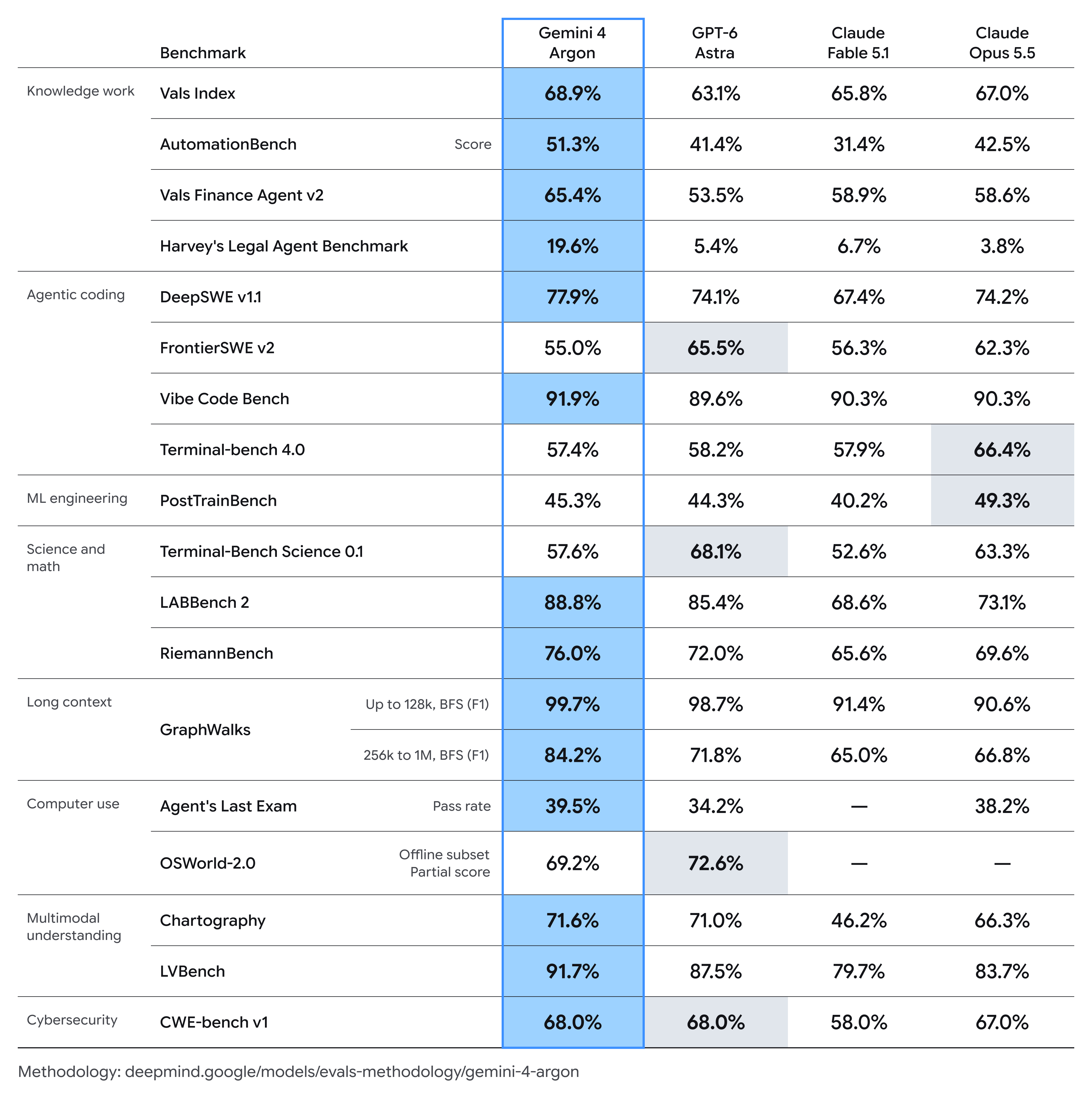
On AutomationBench, a Zapier evaluation focused on completing business workflows, Argon ranked first with a score of 51.3%. Google also reported leading results on finance and legal benchmarks, along with a score of 91.7% on LVBench for understanding long-form video.
The company is already using Argon in large-scale engineering projects. Google said thousands of employees have tested the model for coding, research and writing tasks.
One internal project used Argon agents to analyze data-center profiling information and identify memory optimizations. Google says those changes freed more than 300 TiB of memory after deployment, with total potential savings estimated between 500 TiB and 1 PiB.
Argon has also been applied to code migration work inside Google. Agents are helping move C and C++ codebases to Rust, ranging from smaller libraries to more than 800,000 lines of code for the Fuchsia Zircon kernel.
In another project involving libgav1, Google’s open-source video decoder, Argon agents replaced 32,000 lines of SIMD code in an existing Rust port. Google says the resulting version runs 2.7 times faster than the previous Rust implementation while producing identical video output.
Quantum computing researchers at Google have also used Argon for algorithmic optimization. In one case described by the company, the model reduced the spacetime resources required for a bottleneck subroutine by 40% compared with a published baseline.
Cybersecurity is a central focus of the initial rollout. Google says Argon can identify, verify and patch software vulnerabilities and will initially be available without cyber guardrails to selected defenders and internal security teams.
The model tied for first on CWE-bench v1 with a score of 68%, according to Google. CNBC reported that Argon matched OpenAI’s GPT-6 Astra and Grok 4.7 on cybersecurity benchmarks while outperforming GPT-6 Astra and recent Anthropic models on the Vals Index.
Google also says Argon substantially improves on its 3.8 Flash Cyber model in vulnerability discovery. On the company’s internal security benchmark, Argon found exposures across codebases covering 20 programming languages.
Wiz is already testing Argon through its Scan for Good initiative, which focuses on identifying security weaknesses in critical public infrastructure. Google says the model found a critical vulnerability affecting healthcare software used by hospitals worldwide that earlier frontier models had not identified.
“We really believe that a model of this caliber and this level of frontier performance is meaningfully important for defenders,” Doshi said.
Google is holding back a broader release while it strengthens safeguards in four areas: preventing harmful use, resisting prompt injection attacks, monitoring model behavior for misalignment and securing the environments used to test increasingly capable agents.
The company says Argon was trained to reject harmful requests involving cyber attacks or chemical, biological, radiological and nuclear threats while still allowing legitimate scientific research. Google is also testing techniques that monitor the model’s internal activations for signs of misuse.
For prompt injection, Google says Argon is its most resilient model yet and leads the Gray Swan Indirect Prompt Injection benchmark after adversarial training and automated red-team testing.
Google is also deploying monitoring systems intended to detect when the model takes actions outside a user’s stated intent. Those systems can stop execution when necessary, and the company says similar monitoring was used during Argon’s training.
The model will launch at an introductory price of $2 per million input tokens and $10 per million output tokens. Cached inputs will be priced at a 95% discount from the standard input rate.
Google says broader access will begin with paid API customers and Google AI Ultra subscribers after the initial testing phase. The company has not provided a specific date for that wider rollout.
This analysis is based on reporting from Google & CNBC.
Images courtesy of Google.
This article was generated with AI assistance and reviewed for accuracy and quality.
