Google Cloud CEO Thomas Kurian said the agent can be given “objectives, not just instructions.” In practice, that means a user can hand off a larger goal and let Gemini determine how to execute it.
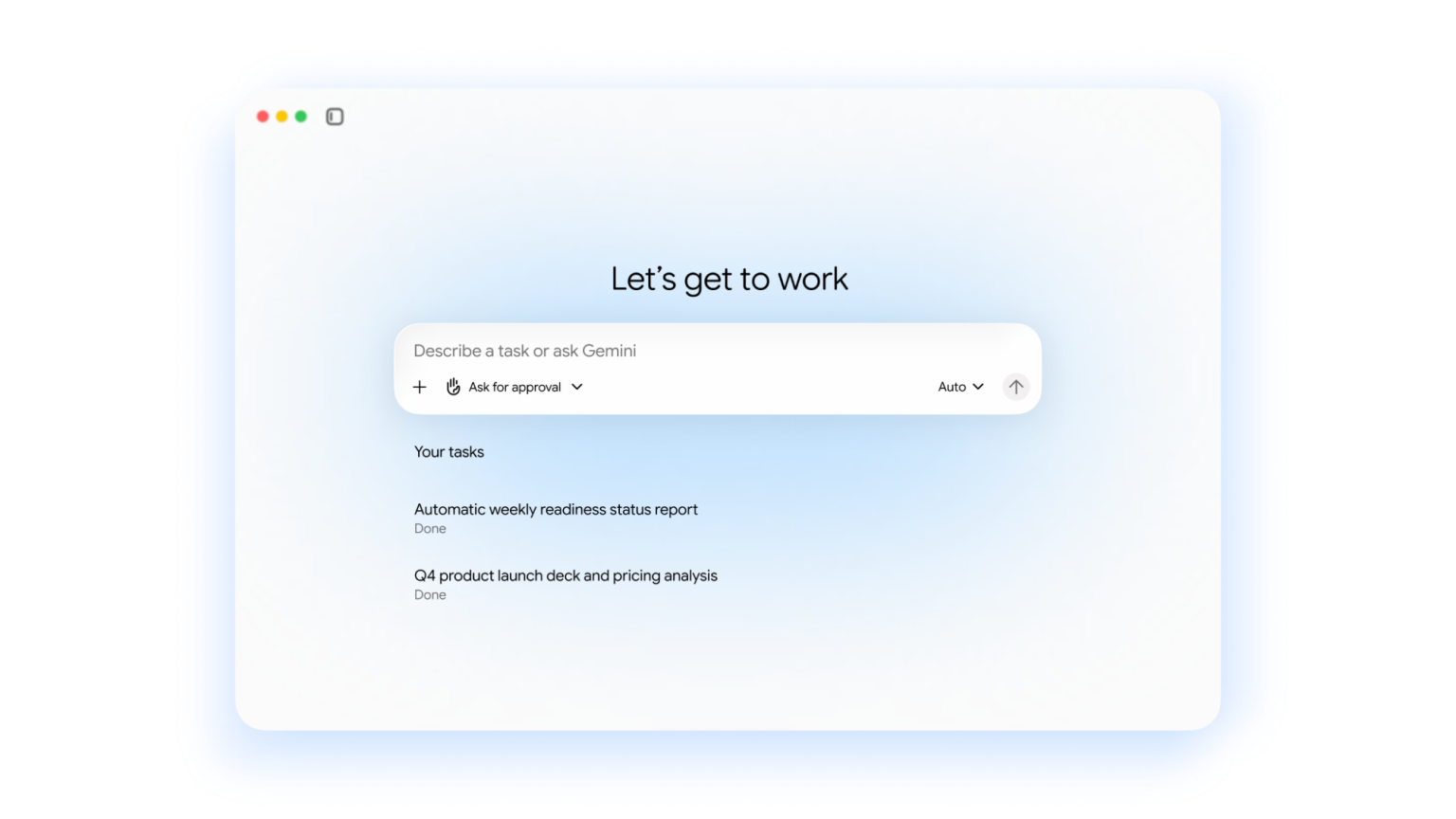
The agent can work across Google Workspace and a range of third-party services, including Microsoft 365, Slack, Jira, Confluence, Git, BigQuery, Databricks, Postgres and Snowflake. It can also connect to Model Context Protocol servers located inside or outside a company’s network.
Users can attach files, folders and project materials to a request, allowing Gemini to work with context tied to a specific workflow. The system can also create temporary subagents for separate pieces of a job and coordinate them as part of a larger task.
Google says the agent will select the model it considers best suited to a request by default. Users can override that choice and select a model themselves, including third-party options. Anthropic’s Claude models will be available first, with support for additional open source and private models planned later.
A “tasks inbox” gives users a way to follow the agent’s work. From that interface, they can see progress, code execution, special skills being loaded and tasks being delegated to subagents.
Google is also giving the agent its own Workspace identity. It can have a separate email address and maintain its own context, allowing employees to interact with it more like a colleague. Users can tag the agent, email it, share material with it or add it to group conversations.
The agent can use organizational context such as team structures, time zones, calendars and approval requirements when carrying out work. Actions performed by the system are recorded in an audit trail under the agent’s identity rather than attributed to a human employee.
“Gemini can function as your personal assistant or as a team member, where it works on behalf of a group of people, like a project manager within a team, or on behalf of a specific role in an organization, like an analyst in your finance department,” Kurian said.
Google says Gemini can also build memory and skills from the work it performs, reducing the need for users to repeatedly provide the same background.
“You never have to re-brief it or wonder which machine you told it to do something on,” Kurian said.
The agent will be accessible through iOS and Android devices, Windows and Mac computers, the command line, Google Workspace, Microsoft 365, ServiceNow and Slack.
Google is starting with businesses, where Gemini already has a substantial presence. CEO Sundar Pichai said Gemini has more than 1 billion monthly active users overall, while nearly 90% of Fortune 100 companies use Gemini Enterprise.
Pichai said beginning with enterprise customers will give Google a chance to address “harder problems around security, scale, and performance” before expanding the agent more broadly.
Early testers include On, Shopify and PayPal. Google also named BNP Paribas, Bradesco, Merck, Orange Spain, Santee Cooper, SOMPO, Ulta Beauty and Wesfarmers among Gemini Enterprise customers.
The company is also adding enterprise spending controls, including multi-model orchestration, smart routing and real-time spending caps. Those tools are intended to help businesses manage the cost of using multiple AI models and agents across large organizations.
With the new Gemini agent, Google is moving its workplace AI from a primarily conversational assistant toward a system that can accept broader goals, coordinate tools and models, and carry out work across the software employees already use.
This analysis is based on reporting from Google & CBS News.
Images courtesy of Google.
This article was generated with AI assistance and reviewed for accuracy and quality.
