The largest measured improvements appear in software engineering. Gemini 3.7 Flash scored 65.3% on DeepSWE v1.1, compared with 49.0% for 3.6 Flash. On FrontierCode 1.1 Main, its result increased from 34.4% to 43.6%. Google says the model is also more accurate on its initial coding attempts and performs better when debugging or resolving software issues.
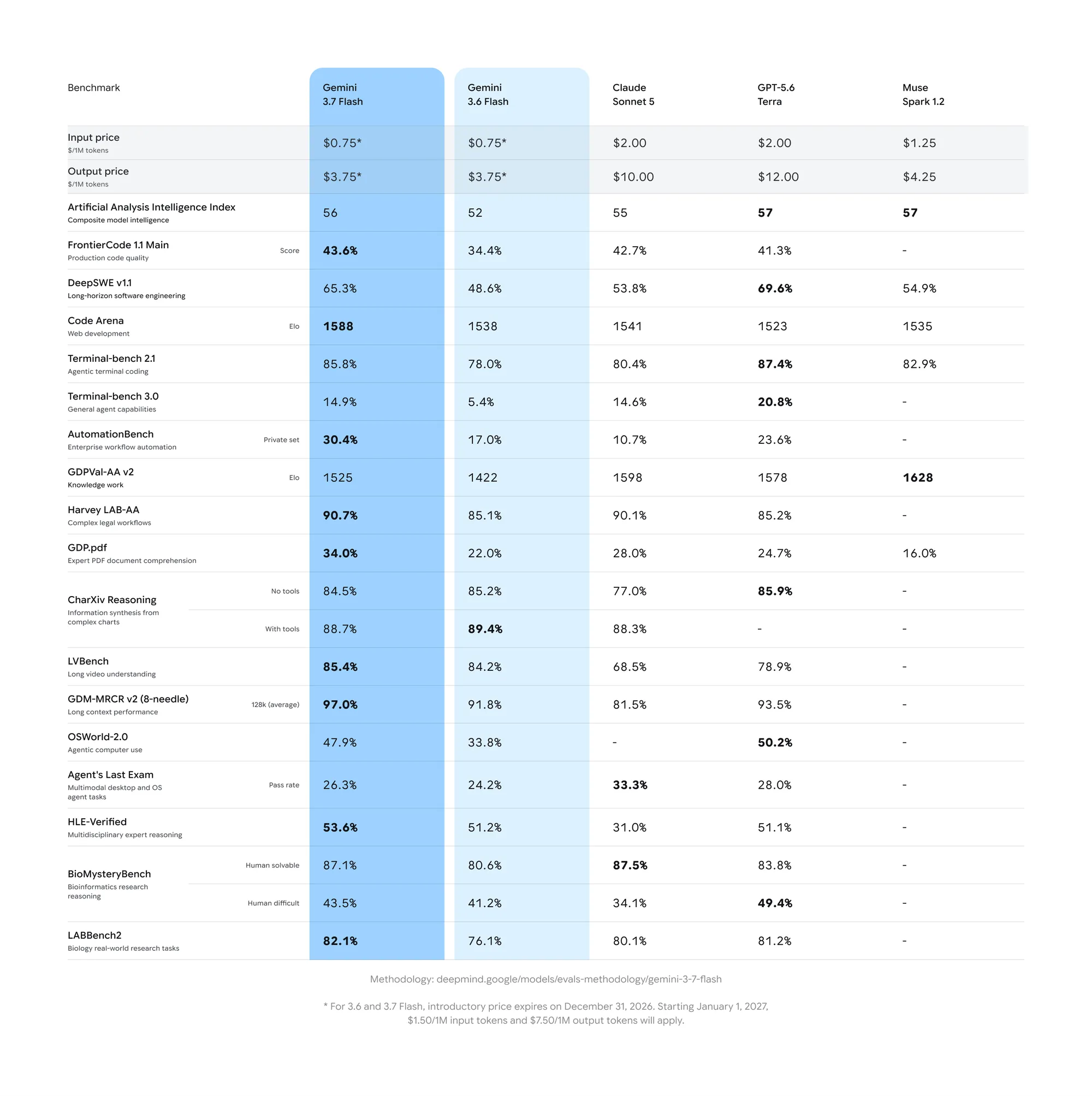
Web development received another performance boost. Google says 3.7 Flash can produce more complete applications and functional layouts with fewer prompts while maintaining stronger adherence to reference designs. Those references can include screenshots, images or complete design systems. Its WebDev Arena Elo score on Arena.ai reached 1588, versus 1538 for Gemini 3.6 Flash.
Google is also targeting workloads outside software development. On GDP.pdf, which evaluates how models handle complicated documents, Gemini 3.7 Flash scored 34.0%, up from 22.0% for its predecessor. Its AutomationBench result rose from 17.0% to 30.4%, reflecting improved performance on business workflow tasks.
The company says those improvements extend to areas that require substantial domain knowledge, including finance, law and biosciences. Google demonstrated the model handling tasks ranging from converting reports into interactive data experiences to coordinating agents for web development and using multimodal inputs in robotics training.
The lower introductory pricing is particularly relevant for agent-based applications, where repeated model calls can accumulate as software works through longer sequences of actions. Google says the combination of higher performance and lower token costs is intended to make it more economical to deploy production agents at scale.
Gemini 3.7 Flash is also becoming the underlying model for Gemini Spark starting today. Spark, available to Google AI Pro and Ultra subscribers in more than 160 countries, is designed to operate continuously as a personal agent under the user's direction. With the new model, Google says Spark improves its use of Google Workspace tools and its ability to complete workflows involving several different skills. Those tasks can include bringing files together, preparing emails and updating status documents. The improvements are intended to reduce the amount of intervention required as Spark moves through more complicated knowledge-work assignments.
Google is making Gemini 3.7 Flash available to developers through the Gemini API using Google AI Studio and Android Studio, as well as through Google Antigravity for agent-focused development. Enterprise customers can access the model through the Gemini Enterprise Agent Platform and Gemini Enterprise app.
The release also includes revised Frontier Safety protections covering misuse involving chemical, biological, radiological and nuclear risks, along with cyber offense. Google says the safeguards are designed to strengthen protections in those areas while continuing to support beneficial applications.
Gemini 3.7 Flash arrives only three weeks after its predecessor, pairing the rapid model update with a substantial introductory price reduction. For developers evaluating the Flash series, Google is offering a model that costs less than 3.6 Flash did at launch while posting higher results across each of the coding, web development, document comprehension and workflow benchmarks highlighted with the release.
This analysis is based on reporting from Google.
Image courtesy of Google.
This article was generated with AI assistance and reviewed for accuracy and quality.
