Smart reports are the centerpiece of Anthropic's update. The feature analyzes samples of employee conversations with Claude and organizes activities into workstreams, allowing administrators to examine what teams are accomplishing, how much those tasks cost and where employees encounter difficulties.
Administrators can select specific teams, products and reporting periods to review. The resulting analysis identifies completed work, recurring activities and obstacles such as unsuccessful tool calls or unavailable integrations. It also generates recommendations for improving workflows and making effective practices available across an organization.
For example, reports can identify frequently repeated tasks that could be converted into reusable Claude skills or suggest changes to repository rules that would improve coding workflows. Administrators can also ask customized questions about spending and model usage, save recurring queries as templates and share findings with colleagues.
Anthropic says the reports are intended to help organizations understand adoption and improve deployment decisions, rather than monitor individual employee productivity. The company explicitly states that the feature should not be used to assess individual performance or make employment decisions.
Smart reports are disabled by default, and Anthropic says customer data collected through the reporting process is not used to train its models unless customers choose otherwise.
Early enterprise customers have highlighted the value of understanding how employees use Claude beyond basic activity metrics.
Deloitte Managing Director of AI Transformation Vivek Kulkarni said the reports provide greater visibility into enterprise AI deployment and help identify workflows that can be adopted more broadly.
At DoorDash, AI Enablement Lead John Jannone said the reporting feature revealed patterns he had not previously identified, despite his close involvement with the company's Claude adoption.
The second feature, in-app surveys, adds employee feedback to the usage information collected through smart reports.
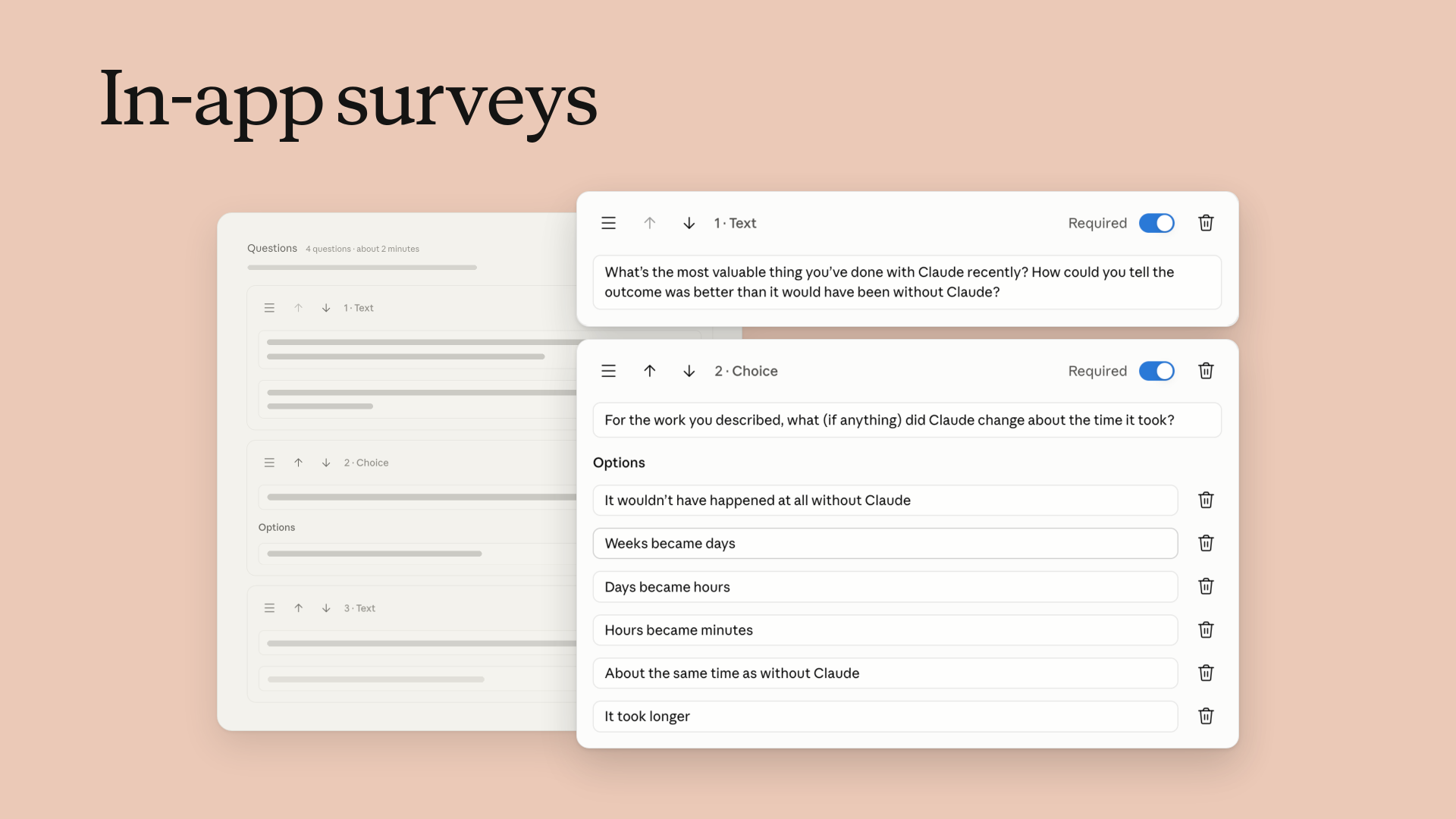
Administrators can create questionnaires that appear directly within Claude after employees receive a response. The surveys can ask users to describe valuable tasks they completed, estimate time savings or identify activities that would become more difficult without access to the AI assistant.
Organizations can customize the questions, determine which employees receive them and control when surveys appear. Responses are available through the administrative console and can be exported to spreadsheets for further analysis.
The surveys are designed to provide a qualitative view of Claude's usefulness alongside the activity and spending data available through reports. They also support organizations using customer-managed encryption keys, with survey responses subject to applicable organizational retention settings.
Anthropic says it treats survey responses as customer data and accesses them only when necessary to operate the service.
The third addition, pooled group budgets, addresses how organizations allocate spending across employees who use Claude at different levels.
Previously, individual monthly spending limits could prevent heavy users from continuing their work even when other employees had unused allowances. Pooled budgets introduce a shared monthly allocation for each group, allowing spending to be distributed according to actual usage.
Individual limits remain in place to prevent unusually high spending by a single employee. Each request counts toward both the user's personal allowance and the group's shared budget, with access restricted when either limit is reached.
Employees can request additional spending capacity directly within Claude, while administrators can review those requests and adjust allocations. The system also recommends initial budgets using historical usage data and sends billing administrators notifications when spending reaches 50%, 75%, 95% and 100% of a group's allocation.
The new controls arrive as spending on AI development tools increases. A recent Jellyfish analysis covering 276,000 users found that tools powered by Anthropic models accounted for nearly one-third of proposed code changes submitted for review.
The report also found that spending on those tools had increased tenfold since the beginning of the year, reaching approximately 2% of total engineering costs.
That growth creates a budgeting challenge for businesses adopting AI coding assistants. Even when the technology represents a relatively small share of overall engineering expenditure, rapid increases can make costs difficult to forecast.
Anthropic's new reporting and budgeting features address that problem by helping customers identify productive uses of Claude, locate operational bottlenecks and distribute spending more deliberately.
The announcement also comes during an important period for Anthropic's enterprise business. The company filed for an initial public offering earlier in the week, while financial information shared with investors showed an operating profit in the second quarter and strong growth in spending among existing customers.
Anthropic reported 900% net revenue retention for Claude Code, indicating that revenue from the same customer group increased ninefold between the third quarters of 2025 and 2026.
Competition for enterprise AI customers remains significant, particularly as OpenAI expands its coding and business offerings. However, organizations that have already integrated AI assistants into development processes may face substantial costs when switching platforms, including the need to rebuild workflows and retrain employees.
By providing more detailed operational insights, Anthropic is giving existing customers additional tools to evaluate and refine their deployments without relying entirely on outside consulting or internal analysis.
All three features are now generally available for Claude Enterprise customers, although eligibility depends on organizational configurations, including certain HIPAA-related settings and customer-managed encryption arrangements.
The update gives businesses a more structured way to connect Claude usage with spending and reported outcomes. Rather than measuring adoption solely through the number of users or tokens consumed, organizations can examine completed work, employee feedback and recurring problems to determine where their AI investments are producing value and where adjustments may be needed.
This analysis is based on reporting from ZDNET & Claude.
Images courtesy of Claude.
This article was generated with AI assistance and reviewed for accuracy and quality.
