Scheduled deployments give agents a built-in cron schedule, allowing them to launch new sessions and complete assigned tasks without requiring customers to build or host separate scheduling infrastructure. Anthropic says the feature is designed for recurring workflows such as nightly data synchronization, weekly compliance checks, and daily reporting.
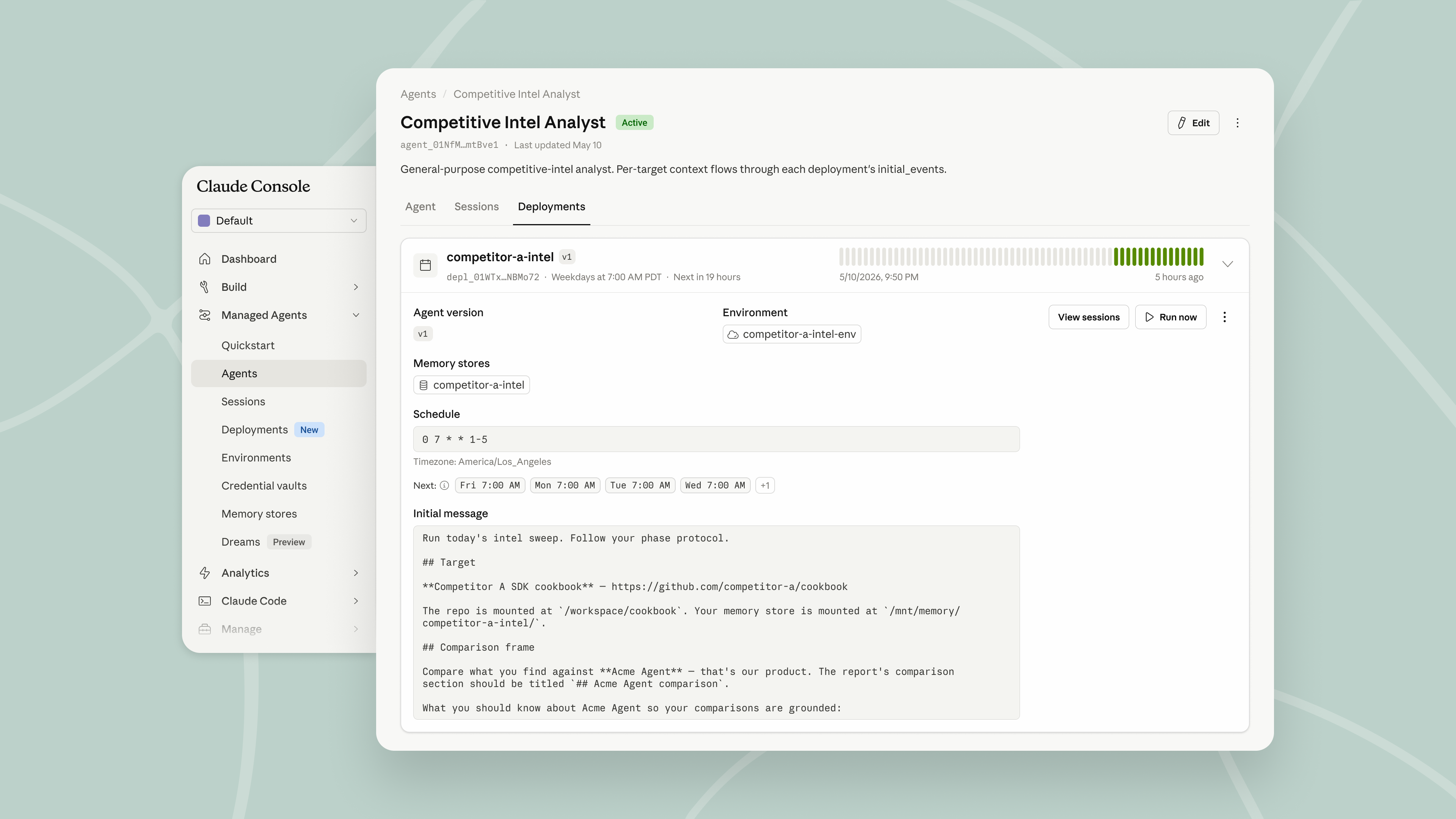
Once deployed, scheduled agents can be paused, resumed, archived, or triggered manually when needed.
Several customers are already using the capability in production environments. Rakuten uses scheduled deployments to analyze spreadsheet data and generate reports and presentations, while Actively AI relies on the feature to refresh answers for its cross-account sales search platform. Ando uses Managed Agents to monitor channels, follow up on proposed actions, and send meeting reminders automatically.
Alongside scheduling, Anthropic is extending vaults to support environment variables, giving agents secure access to authenticated command-line tools, APIs, and external services.
The company said developers can register API keys with specific environment variable names and approved domains. Agents interact only with placeholder values inside their sandbox, while the actual credentials are attached at the network boundary and restricted to approved destinations.
According to Anthropic, the approach allows organizations to update credentials centrally through vaults, with running sessions automatically picking up changes on future requests. The system supports a range of command-line tools that authenticate through HTTP requests, including Browserbase, KERNEL, Notion, Ramp, and Sentry.
The addition also brings browser automation capabilities to Managed Agents through integrations with Browserbase and KERNEL, allowing agents to navigate websites and interact with web-based services alongside their existing tools.
Customers are already using the new vault functionality to connect agents to authenticated environments. Notion is using environment variables to support its CLI while keeping API tokens hidden from models. Browserbase relies on the system to authenticate its browser automation tools and maintain its public catalog of browser skills. KERNEL uses the feature to connect agents to customer usage databases, while Milana uses it to give agents secure access to customer codebases for bug identification and remediation.
Together, the updates allow Claude Managed Agents to run recurring jobs automatically and securely access authenticated services, reducing the amount of infrastructure organizations need to build themselves.
This analysis is based on reporting from Claude.
Images courtesy of Claude.
This article was generated with AI assistance and reviewed for accuracy and quality.
