According to OpenAI, each Presence deployment begins with a defined business task, such as resolving billing issues, processing insurance claims, or handling employee IT requests. Organizations determine what information an agent can access, which actions it can perform independently, when approvals are required, and when conversations should be escalated to people.
Presence supports real-time voice and chat experiences at launch, including customer support, outbound sales, and internal operational workflows. The platform brings together company knowledge, standard operating procedures, approved actions, guardrails, simulations, evaluation tools, and Codex-powered improvement capabilities to help enterprises manage AI agents after deployment.
Before an agent enters production, teams can evaluate it using simulations that test common requests, edge cases, and higher-risk scenarios. OpenAI said graders verify whether the agent reaches the correct outcome, follows company policies, uses tools appropriately, and escalates interactions when necessary. Guardrails can also intervene when conversations move beyond predefined operational boundaries.
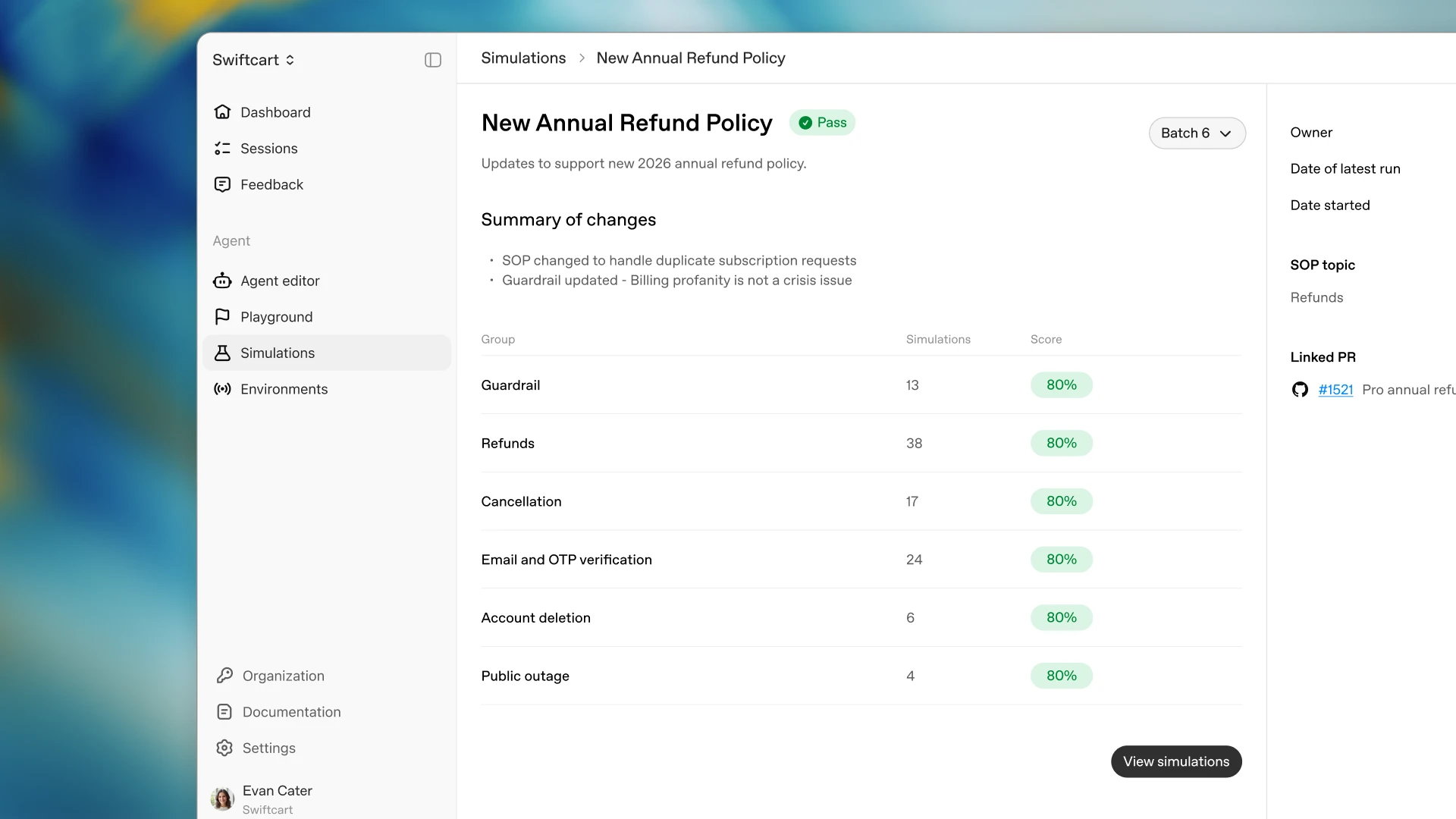
The platform continues monitoring agent performance after launch. OpenAI said production sessions, escalation data, and quality signals help identify where an agent requires improvement. Codex, using a Presence plugin, analyzes those signals and proposes updates that organizations can test against the production version before approving a controlled rollout.
OpenAI said Presence already powers its English-language phone support line at 1-888-GPT-0090, where it handles customer requests, verifies callers, accesses account information, and performs approved actions. According to the company, the system now resolves 75% of inbound issues without human assistance, while its Codex-powered improvement process reduced human handoffs by 15 percentage points within 10 days. OpenAI noted these are company-reported figures.
Several organizations are also evaluating the platform. BBVA is exploring AI-powered voice support for banking customers in Mexico, SoftBank is testing Japanese-language customer interactions, and IAG is evaluating the technology for customer support during high-demand events.
Daniel Ordaz, Head of AI Transformation at BBVA Mexico, said, "At BBVA, we are working closely with OpenAI to explore how trusted customer agents can help shape the future of financial services. As a design partner for Presence, we are working closely with OpenAI to help shape and refine voice experiences for financial customer service, as part of our focus on delivering a faster, more seamless, and more personalized experience across every interaction."
OpenAI also confirmed that Presence uses OpenAI models as the core agent while allowing customers to connect third-party models and services through APIs for guardrails, tools, and other workflow components.
The company has not disclosed pricing, geographic availability, contractual terms, or the expected costs associated with implementation. Presence is currently available only through a limited general availability program led by OpenAI's deployment teams, and it is not offered as a self-service product.
The launch expands OpenAI's enterprise strategy beyond APIs by packaging deployment services together with governance, evaluation, and operational controls designed for production AI agents. OpenAI said it will continue supporting voice customers through the OpenAI API while using Presence to help enterprises deploy agents that can adapt over time without sacrificing organizational oversight.
This analysis is based on reporting from OpenAI.
Images courtesy of OpenAI.
This article was generated with AI assistance and reviewed for accuracy and quality.
