“Our nation depends on our men and women who fight on the front lines. Nothing is more valuable to you than information and insight, and information and insight in a timely way, and to understand its impact and consequence,” NVIDIA founder and CEO Jensen Huang said. “I can’t imagine anything more important.”
The DGX GB300 becomes the centerpiece of NVIDIA's AI Technology Center at the Monterey campus, a dedicated facility for graduate instruction and AI research. According to NVIDIA, the system will support more than 1,500 in-resident students and 600 faculty members by enabling foundation model training, large-scale simulations and development of AI applications with direct operational relevance.
“As we modernize our technology, we must also modernize how we educate our leaders,” said Admiral Samuel Paparo, commander of the U.S. Pacific Command. “Access to advanced computing capability means NPS students and faculty understand the opportunities and responsibilities that come with these technologies.”
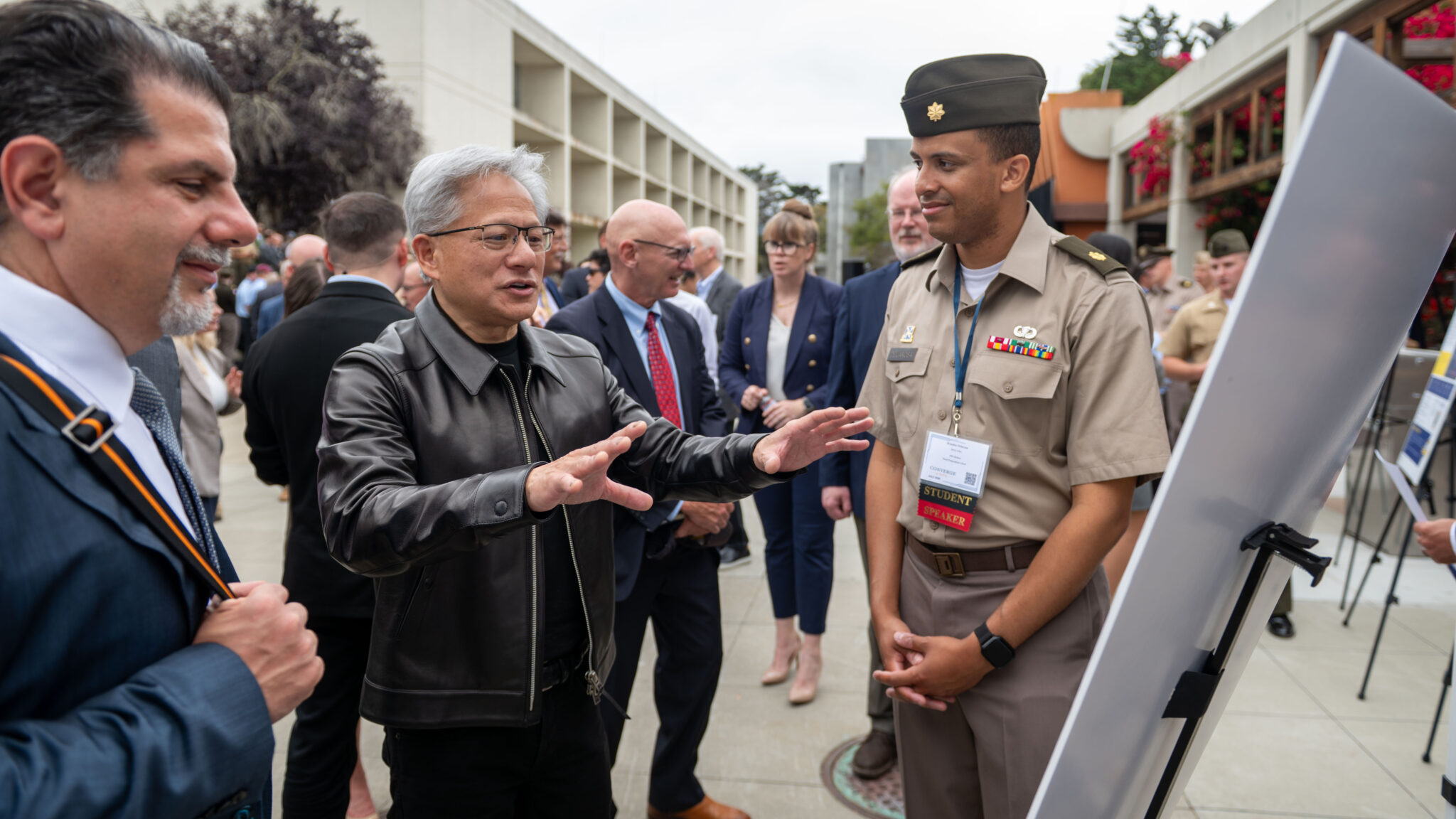
NPS educates active-duty military officers and international partners across disciplines ranging from space operations to ocean science, with graduate programs centered on applied research. Huang said advances in AI are making the technology more accessible beyond traditional computer science fields.
“Leadership is about being in service of something else. You’re in service of your team. You’re in service of your country. You’re in service of your mission,” Huang said. “And all of this technology is just tools to help you.”
He also encouraged attendees to begin using AI regardless of their technical background. “The most important advice that I would give to someone is to engage the technology,” Huang said. “It’s not as hard as you think it is, and the reason for that is because, on first principles, technology is supposed to get smarter and smarter over time.”
NVIDIA has also expanded its collaboration with the school through its Deep Learning Institute by providing instructor toolkits designed to integrate AI across graduate programs.
“Many of you will command in AI-enabled environments. Information will move at lightning speeds, compressing response times,” Paparo said. “Our advantage will come from leaders, like you, who can use the technology to see, understand, decide and act faster while exercising the judgment, experience and leadership that machines cannot provide. That education is happening here at NPS.”
Researchers at NPS are using AI for projects including ocean modeling, atmospheric prediction and digital twin development. The DGX GB300 is expected to support those workloads on campus, including a digital twin framework developed with nonprofit organization MITRE using NVIDIA Omniverse libraries to simulate navigation and decision-making in complex environments.
The deployment was supported by several NVIDIA ecosystem partners. DDN supplied high-performance data infrastructure for AI workloads, VAST Data provided a unified data platform for managing data across edge, core and cloud environments, and Vertiv delivered the racks, cooling, power infrastructure and commissioning support needed to bring the system online.
This analysis is based on reporting from NVIDIA.
Images courtesy of NVIDIA.
This article was generated with AI assistance and reviewed for accuracy and quality.
