"Someone scrolling through Instagram can tap a clip of your game and be in a multiplayer session within seconds, without needing to download an app or being redirected," Meta wrote in its announcement. "Your game lives natively in the feeds where people already discover content and connect with friends."
Meta says its recommendation systems will give more visibility to games that are engaging, technically stable, culturally relevant, and successful at bringing players back. That makes distribution a major part of the pitch: creators are not only being given tools for building games, but a potential route to players through Meta’s existing social feeds.
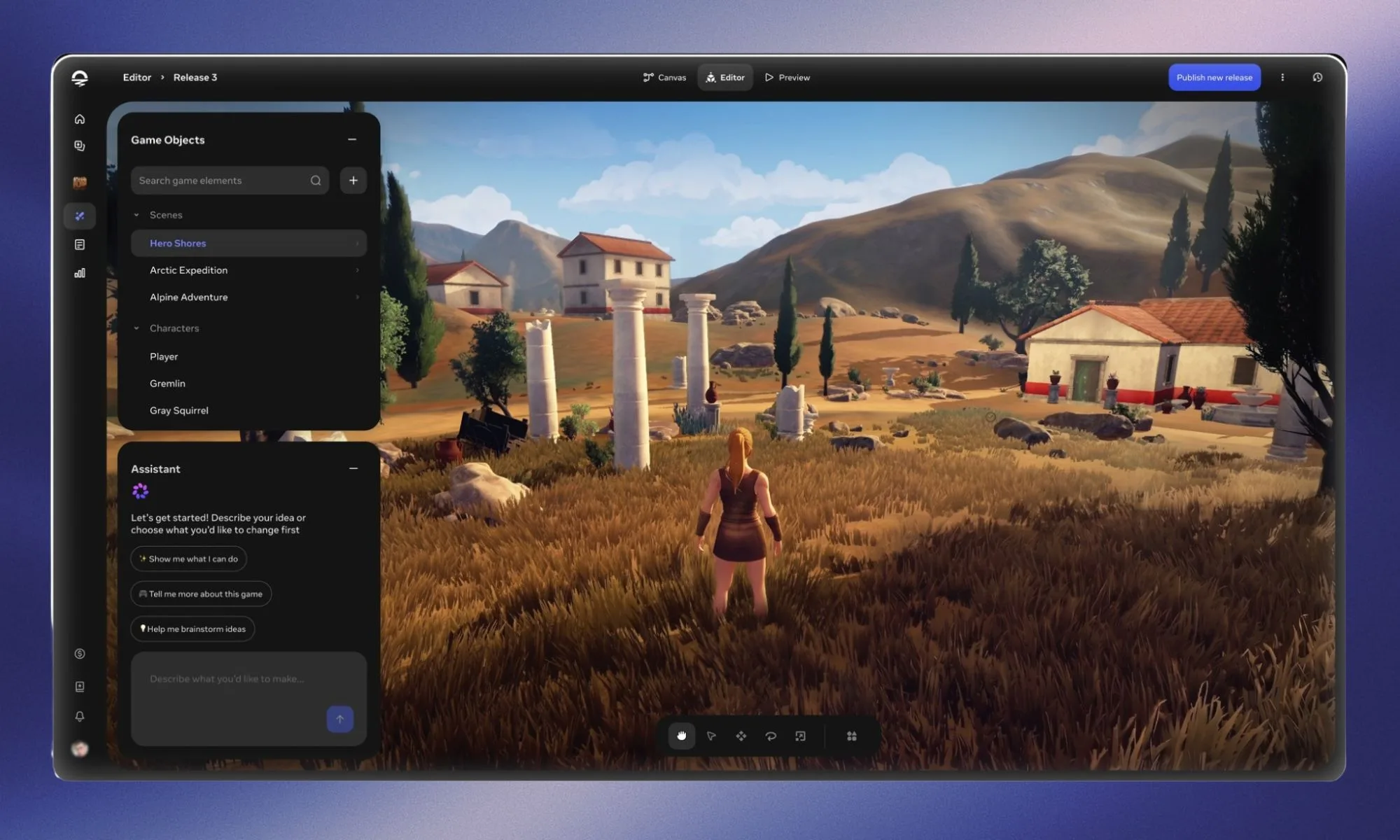
Horizon Create takes the simpler approach. Users can describe an idea in natural language or begin with an existing template, then have the system generate a playable game. Meta says the resulting projects can include progression, difficulty balancing, art direction, and multiplayer features. Creators can continue refining characters, stories, and visual styles through additional prompts.
Game generation can continue while users do other things on their phones, with a notification appearing when a project is ready for playtesting. Several projects can also be generated at the same time.
Horizon Studio extends that workflow to the browser and provides more detailed editing options. Creators can rearrange scenes, replace assets, and manually modify scripts without installing development software or using a gaming PC. Create and Studio share the same backend, allowing projects and their assets, systems, and iteration history to move between mobile and browser.
Meta says games must also pass safety checks and receive an automated age rating before publication.
The release gives Meta another way to expand Horizon beyond its roots in virtual reality. The platform reached roughly 300,000 monthly users when The Verge last reported the figure in early 2022, and Meta has since shifted its focus increasingly toward mobile.
Roblox provides a much larger comparison point, with 123 million daily active users. It has also introduced prompt-based game generation inside its mobile app, putting both companies behind a similar idea: reducing the technical work required to create user-generated games.
Other game-development platforms, including Unity, are exploring prompt-driven creation as well. Meta's approach combines that generation layer with built-in distribution through Facebook and Instagram, potentially putting games in front of users who were not actively looking for something to play.
The scope of Meta's tools is also broader than systems that primarily generate short interactive scenes. Meta describes Horizon Create and Studio as capable of producing games with elements including progression, balanced difficulty, art direction, and multiplayer rather than only a standalone environment.
Google's Project Genie, by comparison, generates short interactive experiences but does not provide the objectives, scoring systems, or session structures associated with a more conventional game.
The remaining question is how consistently Meta's tools can produce games people want to keep playing. Making game creation easier could dramatically increase the amount of content published through Horizon, but Meta's own ranking criteria suggest the company expects recommendation systems to separate stronger projects from weaker or less stable ones.
For Horizon, that distribution advantage may be as important as the generation technology itself. Instead of asking users to discover Horizon as a separate destination, Meta can place playable experiences directly into the Facebook and Instagram feeds they already use. Horizon Create and Studio provide the tools for producing those games; Meta's social platforms provide the audience.
This analysis is based on reporting from digitaltrends.
Images courtesy of Meta.
This article was generated with AI assistance and reviewed for accuracy and quality.
