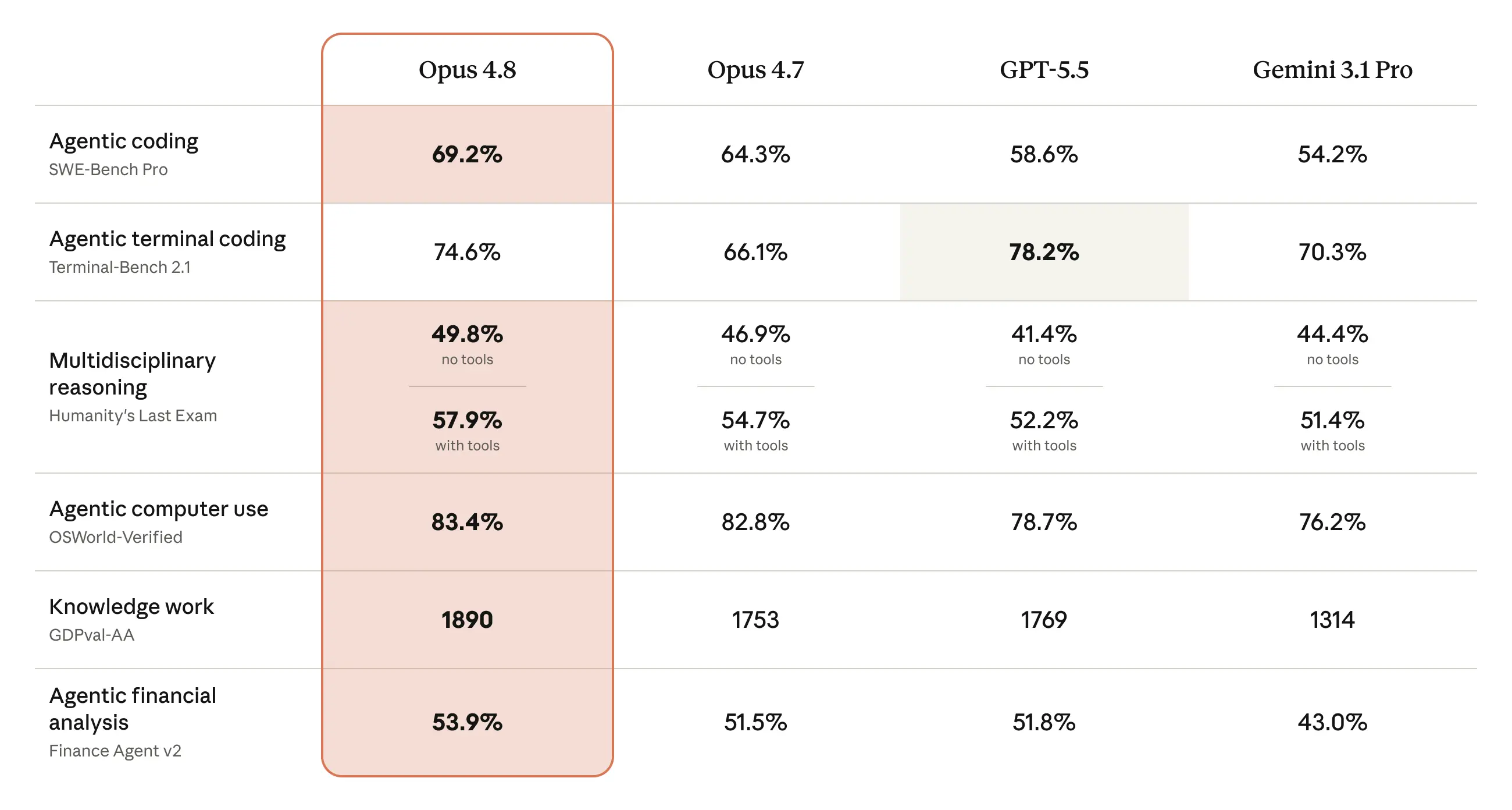
Anthropic has released Claude Opus 4.8, an upgraded version of its flagship AI model that adds new controls for reasoning effort, lower-cost high-speed performance, and expanded agentic coding capabilities through Claude Code.
The company said Opus 4.8 improves on Opus 4.7 across coding, reasoning, practical knowledge work, and agentic tasks while keeping standard pricing unchanged. Anthropic is also introducing several new platform features alongside the model update, including “dynamic workflows” for Claude Code and adjustable effort settings inside claude.ai.
One of the biggest additions is a new effort control system that lets users decide how much reasoning power Claude applies to a task. Anthropic said higher effort settings allow the model to “think more frequently and more deeply,” while lower effort settings prioritize faster responses and lower rate-limit usage. The controls are now available across all plans.
Anthropic also launched a faster operating mode for Opus 4.8 that runs at roughly 2.5 times the speed of the standard version. According to the company, fast mode pricing is now three times cheaper than it was for earlier models.
The release places heavy emphasis on coding and autonomous software workflows. Claude Code now includes a research preview feature called “dynamic workflows,” which allows Claude to coordinate hundreds of parallel subagents inside a single coding session. Anthropic said the system can plan tasks, execute codebase-scale migrations across hundreds of thousands of lines of code, verify outputs, and return completed work to users.
The feature is currently available for Claude Code users on Enterprise, Team, and Max plans.
Anthropic also highlighted improvements in reliability and honesty, particularly during agentic tasks where AI systems can sometimes overstate progress or overlook errors. The company said evaluations showed Opus 4.8 was “around four times less likely” than Opus 4.7 to leave flaws in generated code unacknowledged.
The company’s Alignment team said the model “reaches new highs on our measures of prosocial traits like supporting user autonomy and acting in the user’s best interest.” Anthropic also said rates of problematic behaviors, including deception and misuse cooperation, were lower than Opus 4.7 and closer to the company’s Claude Mythos Preview model.
Anthropic is additionally updating its Messages API to support system entries directly inside the messages array, allowing developers to change instructions during a running task without interrupting prompt caching or rerouting updates through a user turn.
The company said Opus 4.8 defaults to a high-effort reasoning mode designed to balance performance and usability, though users can choose “extra” or “max” effort settings for harder tasks and longer workflows. Anthropic said it increased Claude Code rate limits to support the higher token usage associated with those modes.
Anthropic also used the launch to preview its next phase of model development. The company said organizations participating in Project Glasswing are already testing Claude Mythos Preview for cybersecurity work, though Anthropic said models at that capability level require additional safeguards before wider release.
Claude Opus 4.8 is available starting today through claude.ai and the Claude API under the model name “claude-opus-4-8.” Standard pricing remains $5 per million input tokens and $25 per million output tokens, while fast mode pricing is set at $10 per million input tokens and $50 per million output tokens.
See more here:
This analysis is based on reporting from anthropic.
Images courtesy of Anthropic.
This article was generated with AI assistance and reviewed for accuracy and quality.
About this article: This article was generated with AI assistance and reviewed by our editorial team to ensure it follows our editorial standards for accuracy and independence. We maintain strict fact-checking protocols and cite all sources.
Word count: 560Reading time: 0 minutes
Explore More AI Resources
Continue with high-value guides related to this topic.
Join thousands of weekly readers — the latest AI news, free in your inbox.
🤖 3 times a week📊 Industry analysis💡 Breaking news
Enjoying this article?
Get a free month of ChatAI Plus or Pro
🎁 Limited time offer
🔒 Once per user
ChatAI Plus & Pro unlock multi-model chat (GPT, Claude, Gemini & more), our productivity tools, and ad-free reading. Subscribe to our newsletter and take a 2-minute survey to claim one month free — no strings attached.