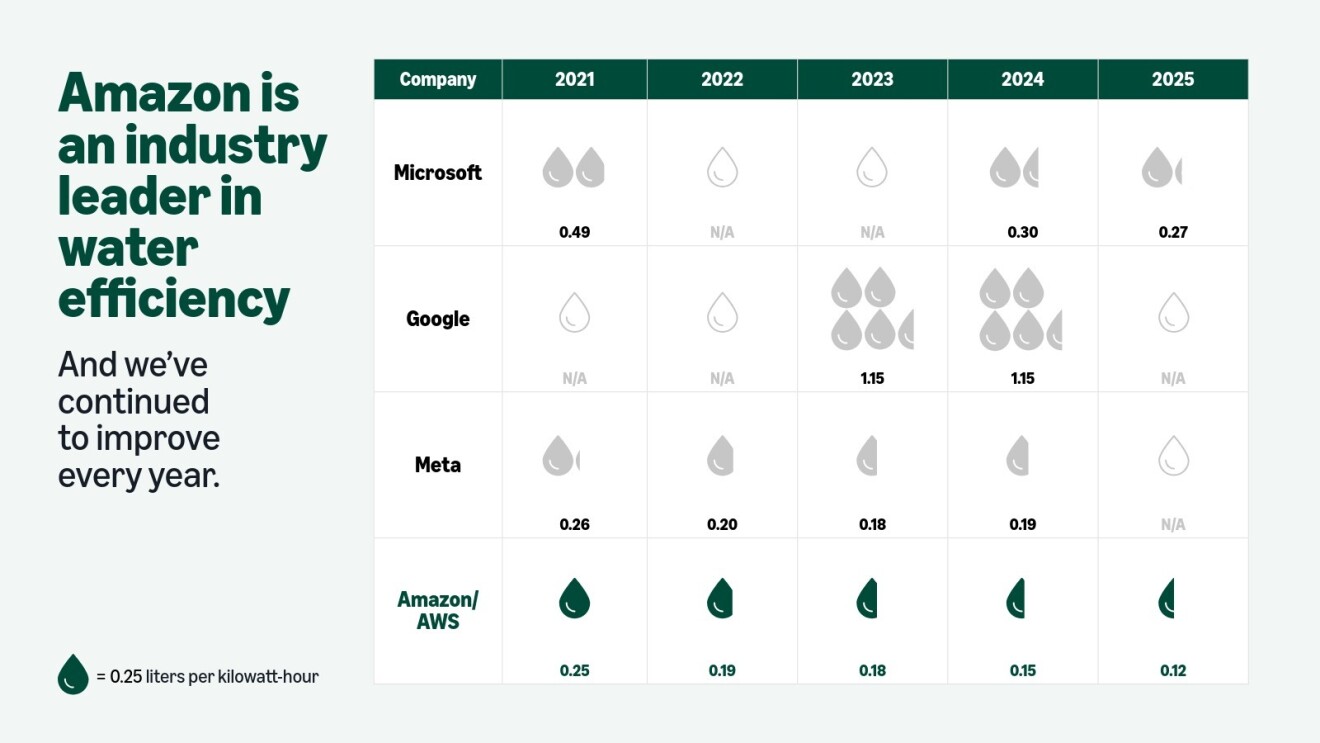
The announcement highlights Amazon’s efforts to reduce the amount of water required to cool data centers as demand for cloud computing continues to grow. According to the company, about 90% of the time its facilities rely on outside air to cool servers, avoiding water use altogether. Water-based cooling is primarily reserved for the hottest periods, when air temperatures and humidity levels make air-only cooling less effective.
Amazon said years of engineering changes have helped lower water consumption. One of the key adjustments involved increasing the operating temperature thresholds of its data centers and designing servers to withstand warmer conditions. By allowing equipment to run at higher temperatures, the company said it reduced the number of hours when water-based cooling is required.
“This is how we innovate at Amazon,” said Joern Tinnemeyer, a data center engineering leader at Amazon. “We set an ambitious target that benefits our customers, iterate relentlessly, and validate with data—in this case, proving we could cut water use in half without any impact on performance.”
The company said internal testing involved analyzing thousands of hours of operational data across data center campuses to monitor equipment performance at higher temperatures. According to Amazon, the approach enabled substantial water savings, including a reported 42% year-over-year reduction in water use in Northern Virginia, its largest region by IT load, while computing demand continued to increase.
When water is needed, Amazon uses evaporative cooling systems that lower air temperatures through evaporation before air reaches servers. The company said it favors this approach over conventional chillers because currently available chiller technology typically requires 25% to 35% more electricity, increasing power demand during periods when electrical grids are already under strain.
“It’s like sweating,” said Amazon water specialist Beau Schilz. “The evaporative process pulls the heat off of your body so you don’t overheat.”
Alongside efficiency improvements, Amazon emphasized its use of reclaimed water sourced from wastewater treatment facilities rather than drinking water supplies. The company said it operates 26 facilities using 100% reclaimed water and has contracts in place for 130 additional facilities globally. It also cited projects in Mississippi, Hong Kong, and Indonesia where it has supported the development of reclaimed-water infrastructure and permitting efforts.
“We’re not just using reclaimed water,” said Usman Khan, a water specialist at Amazon for over seven years. “We’re helping communities develop these programs from the ground up.”
Amazon reported withdrawing about 2.5 billion gallons of water across its global data center footprint in 2025. To offset that usage, the company said it has announced more than 50 water-related projects that are expected to return more than 5.8 billion gallons of water annually once fully implemented.
Those initiatives include aquifer storage work in Hermiston, Oregon, a runoff-water pipeline project in northeastern Spain, and watershed restoration efforts near Guadalajara, Mexico. According to Amazon, the combined projects are intended to increase water availability for local communities and ecosystems.
The company said its broader objective remains becoming water positive by 2030, meaning it aims to return more water to communities than it consumes in its data center operations. In 2025, Amazon said it returned three gallons of water for every four gallons used.
“We’re particularly focused on areas where there’s water scarcity,” Schilz said. “Amazon wants to partner with communities to ensure our water stewardship creates local benefits that they want to see.”
This analysis is based on reporting from Amazon News.
Hero image courtesy of 3 Magazine. Water efficiency chart courtesy of Amazon.
This article was generated with AI assistance and reviewed for accuracy and quality.