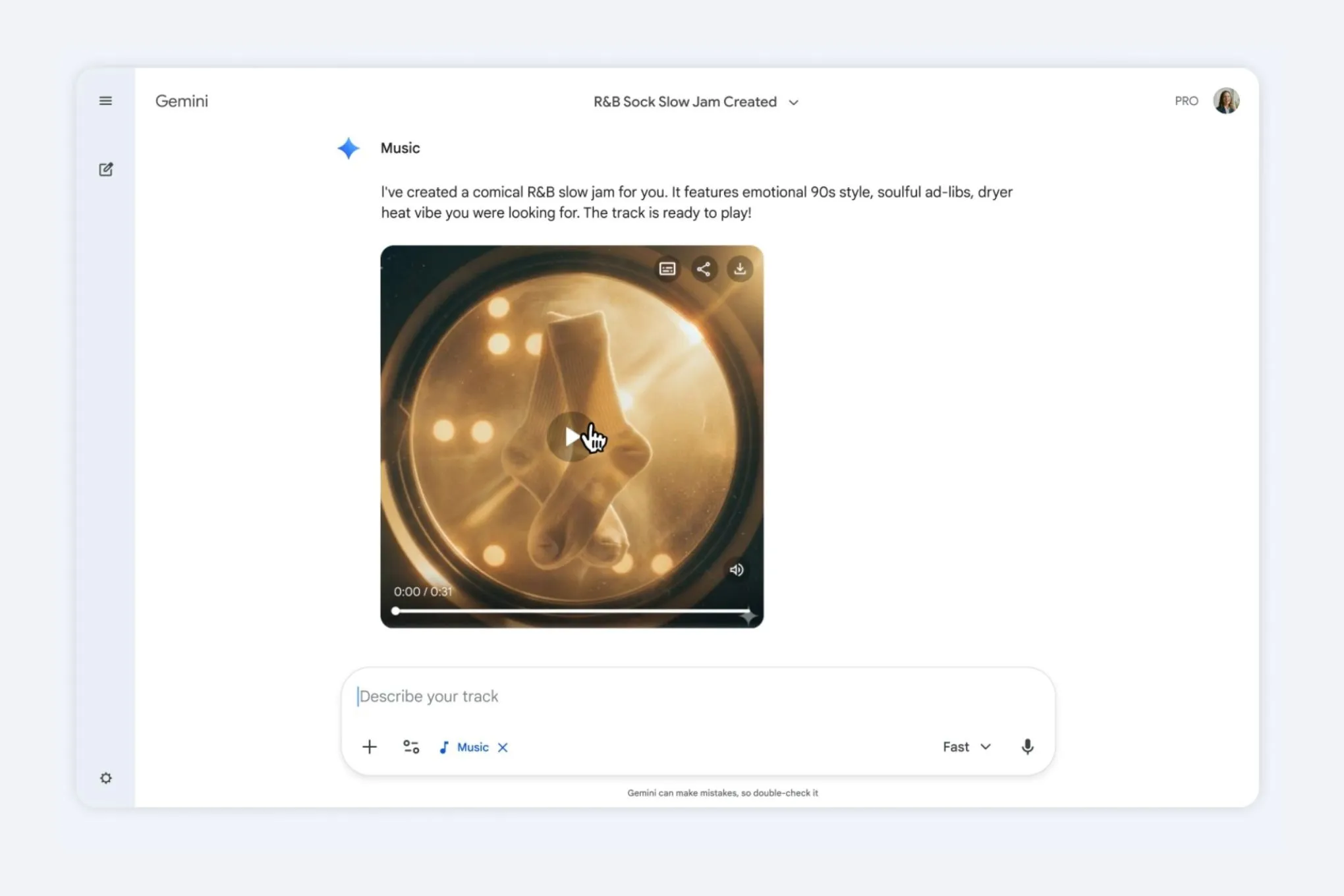
Lyria 3 is an upgrade from Google’s previous music-generation systems, with the company saying it produces more realistic and complex compositions. Music generation is rolling out to Gemini users aged 18 and older worldwide, with support for English, German, Spanish, French, Hindi, Japanese, Korean and Portuguese.
Alongside the Gemini integration, Google is widening the reach of Dream Track on YouTube, a tool that helps creators produce AI-generated music for videos. Previously limited to U.S. creators, Dream Track will now be available globally.
Google emphasized that Lyria 3 is designed for original creation rather than imitation. While users can reference an artist in a prompt, Gemini will interpret that as broad inspiration and generate music in a similar style or mood rather than directly copying a specific performer. The company said it has filters in place to check outputs against existing content.
To address transparency concerns, all songs created with Lyria 3 will include a SynthID watermark, identifying them as AI-generated. Google is also adding a detection feature within Gemini that allows users to upload a track and ask whether it was generated using AI.
AI-generated music continues to divide the industry. Platforms such as YouTube and Spotify are experimenting with monetization models and agreements with music labels, while some AI companies face lawsuits over the copyrighted material used to train models. Services like Deezer have introduced their own tools to label AI-generated tracks in an effort to prevent fraudulent streaming.
With Lyria 3 now embedded directly into Gemini and YouTube’s creator tools, Google is expanding its push into generative media — bringing music creation into the same interface already used for text and image generation, while navigating the legal and artistic tensions surrounding AI in the music industry.
This analysis is based on reporting from The Verge.
Image courtesy of Google.
This article was generated with AI assistance and reviewed for accuracy and quality.
